Bad is stronger than good: the psychology that keeps us reading the worst
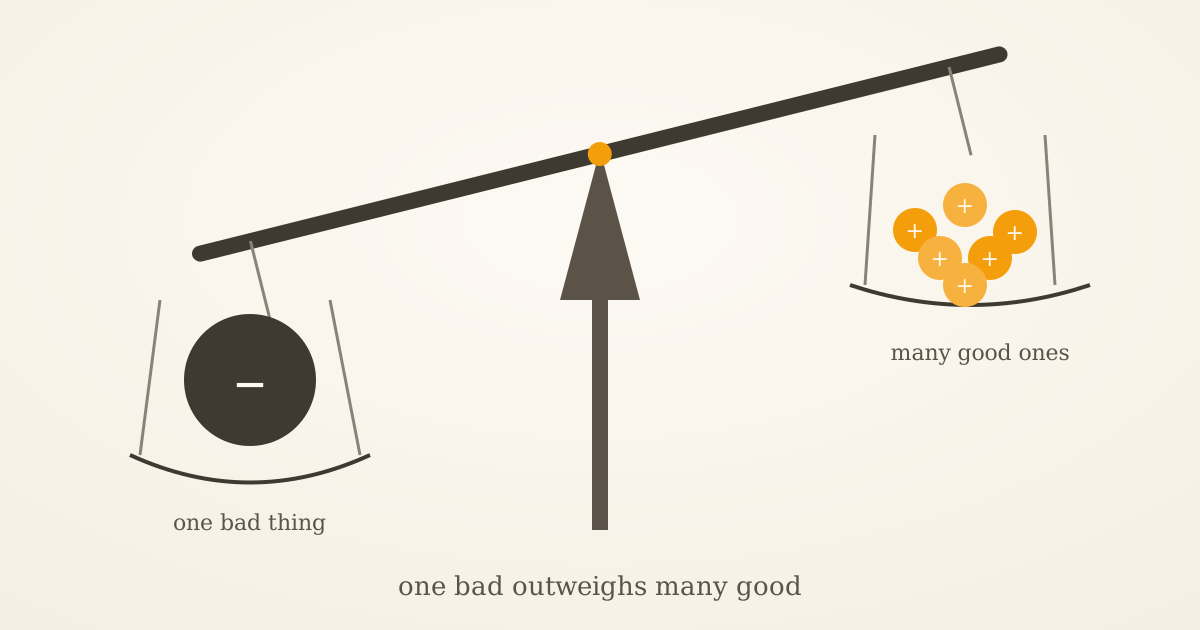
Here's a small confession. A while back I wrote a blog post that I was quite proud of, put it out into the world, and got a lovely wave of kind responses. Dozens of them. And then one person left a single grumpy, dismissive comment - not even a mean one, just unimpressed - and guess which one I was still thinking about three days later? Not the dozens of nice ones. The grumpy one. Every time.
Now, I'm not telling you this because I need therapy (well, maybe a little). I'm telling you because it turns out this is not a Rik problem. It's a human problem. It's one of the most robust, well-documented findings in all of psychology, and once you see it, you can't unsee it. It also happens to be the deepest reason the news looks the way it does - and the reason I felt I needed to build Positron in the first place.
So let's talk about why bad is stronger than good.
The asymmetry you already know
You know this in your bones, even if you've never put a name to it. One criticism outweighs ten compliments. A single rude driver can sour a whole morning of otherwise pleasant traffic. A relationship can absorb a hundred small kindnesses and then get knocked sideways by one careless remark. We are, to put it bluntly, much more moved by the bad than by the good - even when the good is objectively bigger, or more frequent, or more true.
Psychologists call this negativity bias, and it's not a vague hand-wave. It's been measured, poked, and replicated for decades. And here's the thing I find genuinely fascinating: it's not one single effect. It's a whole family of them.
Four ways bad beats good
The best map of this I've come across is a 2001 paper by Paul Rozin and Edward Royzman with the wonderfully dry title "Negativity Bias, Negativity Dominance, and Contagion". They break the bias down into four distinct mechanisms, and I think they're worth walking through, because each one maps almost perfectly onto how news works.
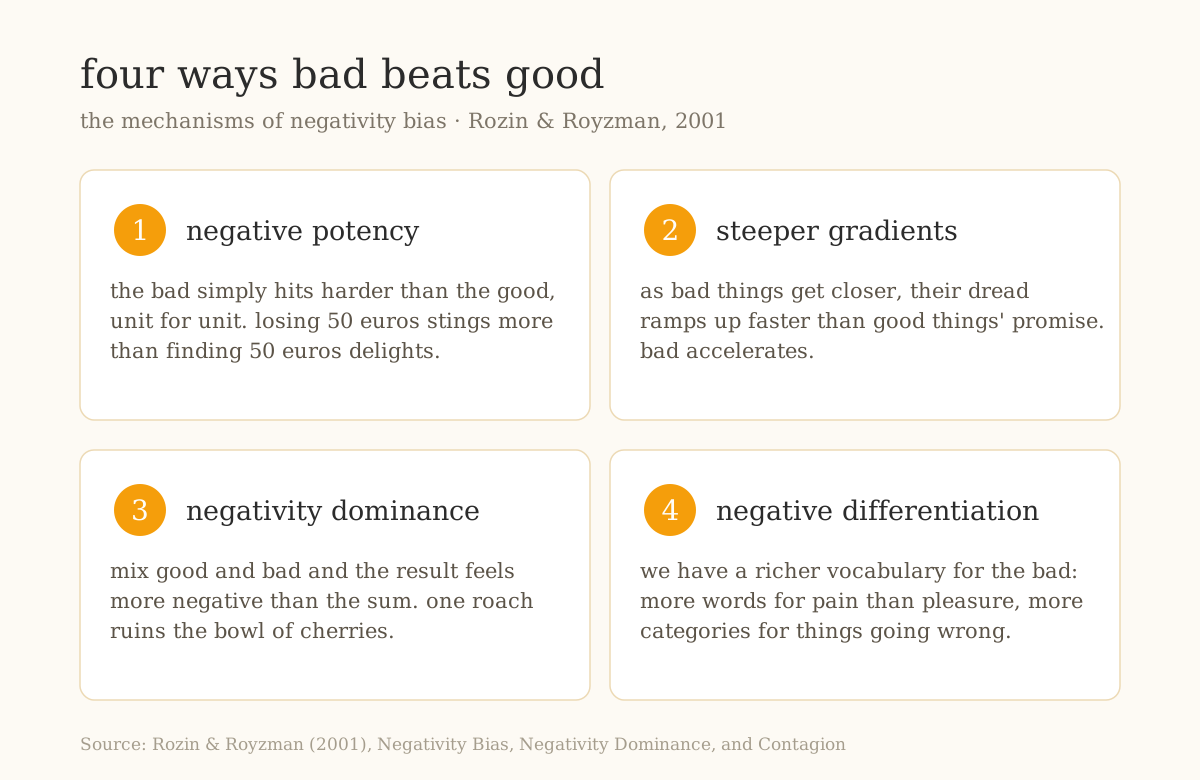
Negative potency. Simply put: negative things are stronger than equally-sized positive things. A loss of 50 euros hurts more than a gift of 50 euros pleases. The bad isn't just noticed more - it packs more punch, unit for unit.
Steeper negative gradients. As something bad gets closer - in time, in space - its negativity ramps up faster than a good thing's positivity does as it approaches. The dread before a difficult meeting grows sharper the nearer it gets, in a way that pleasant anticipation somehow rarely matches. Bad accelerates.
Negativity dominance. This is the big one. When you combine something good and something bad, the result feels more negative than the two parts should add up to. One cockroach will ruin a bowl of cherries, as Rozin memorably put it - but one cherry does absolutely nothing for a bowl of cockroaches. Bad contaminates good far more easily than good redeems bad.
Negative differentiation. We simply have a richer, more detailed vocabulary and mental toolkit for the negative. More words for pain than for pleasure, more categories for things going wrong than for things going right. The bad is more finely mapped in our heads.
Read those four again with the news in mind, and it's almost uncomfortable how well they fit. Of course a headline about a disaster hits harder than one about a quiet success. Of course dread-inducing stories travel further. Of course a single grim item can colour your whole sense of "how the world is doing" this week.
"Bad is stronger than good" - the receipts
If Rozin and Royzman drew the map, a second landmark paper planted a flag on it. In the same year, Roy Baumeister and colleagues published a sweeping review with a title that just says it plainly: "Bad Is Stronger Than Good".
They went looking across an enormous range of human life - close relationships, emotions, learning, first impressions, how we process feedback, even how a good or bad day bleeds into the next one. And the striking thing, the thing that makes the paper so quotable, is that they went looking for exceptions and couldn't reliably find any. Across domain after domain, bad events had more impact than comparable good ones. Bad feedback teaches faster than praise. Bad impressions form quicker and stick harder than good ones. And - this one stopped me in my tracks - a bad day measurably affects your next day, while a good day mostly just... evaporates.
That original summary has since been cited in over ten thousand scientific papers. This is not a fringe idea. It's about as close to settled as psychology gets.
Why would we be built like this?
The usual explanation - and I want to flag clearly that this is a plausible story rather than a proven fact - is evolutionary. Imagine two of our distant ancestors. One is exquisitely tuned to threats: rustling bushes, unfamiliar faces, a whiff of something rotten. The other is a sunny optimist, more attentive to the nice things. Over enough generations, in a genuinely dangerous world, guess whose descendants are more likely to be around to write blog posts about it.
Missing a piece of good news - a ripe fruit tree over the next hill - cost our ancestors a meal. Missing a piece of bad news - the predator behind the same hill - cost them everything. When the downside is that lopsided, a brain that overweights the bad isn't broken. It's good insurance. The trouble is that the same wiring, dropped into a modern world of twenty-four-hour feeds, becomes something a lot less useful.
The honest caveat
Now, I have to be fair here, and it's a caveat Rozin and Royzman make themselves: negativity bias is strong, but it is not universal. There's a whole body of research on our positive biases too - the ways we lean optimistic about our own futures, remember pleasant events more warmly over time, and generally rate life as better than a strict tally would suggest. Humans are complicated. We are not simply gloomy machines.
I think that's actually the hopeful part of the story, and it's worth sitting with. The negativity bias is a tilt, not a life sentence. It's a thumb on the scale, not the whole scale. Which means it can be consciously, deliberately corrected.
Which is exactly the point
And that, really, is the whole idea behind Positron in a single sentence. If our attention comes pre-tilted toward the bad - and the evidence that it does is about as solid as this stuff gets - then a balanced view of the world doesn't happen by accident. It has to be chosen. You have to put a little weight back on the other side of the scale, on purpose.
That's not naivety. It's not pretending the cockroaches aren't there. It's just refusing to let them ruin the whole bowl of cherries.
In the next article I want to go one level deeper, into the beautiful work of Daniel Kahneman and Amos Tversky - because it turns out there's a precise, almost mathematical account of how we overweight losses, and it explains an awful lot about why "bad news sells" is more than just a newsroom cliché.
Hope this was as interesting to read as it was to dig into.
Cheers / Rik
Slecht is sterker dan goed: de psychologie die ons laat lezen over het slechtste
Hier is een kleine bekentenis. Een tijdje geleden schreef ik een blogpost waar ik behoorlijk trots op was, zette deze de wereld in en kreeg een mooie golf van vriendelijke reacties. Tientallen ervan. En toen liet één persoon een enkele chagrijnige, afwijzende opmerking achter - niet eens een gemene, gewoon niet onder de indruk - en raad eens waar ik drie dagen later nog steeds aan dacht? Niet aan de tientallen leuke. Aan de chagrijnige. Elke keer.
Nu vertel ik je dit niet omdat ik therapie nodig heb (nou ja, misschien een beetje). Ik vertel je dit omdat het blijkt dat dit geen Rik-probleem is. Het is een menselijk probleem. Het is een van de meest robuuste, goed gedocumenteerde bevindingen in de psychologie, en zodra je het ziet, kun je het niet meer ontzien. Het is ook de diepste reden waarom het nieuws eruitziet zoals het doet - en de reden waarom ik het gevoel had dat ik Positron moest opbouwen in de eerste plaats.
Dus laten we het hebben over waarom slecht sterker is dan goed.
De asymmetrie die je al kent
Je weet dit in je botten, zelfs als je er nooit een naam aan hebt gegeven. Eén kritiek weegt zwaarder dan tien complimenten. Een enkele onbeleefde bestuurder kan een hele ochtend van anders aangename verkeerssituaties verpesten. Een relatie kan honderd kleine vriendelijkheid absorberen en dan omver worden gegooid door één ondoordachte opmerking. We zijn, om het bot te zeggen, veel meer geraakt door het slechte dan door het goede - zelfs wanneer het goede objectief groter, frequenter of waarachtiger is.
Psychologen noemen dit negativiteitsbias, en het is geen vage handbeweging. Het is decennia lang gemeten, onderzocht en gerepliceerd. En hier is het fascinerende: het is niet één enkel effect. Het is een hele familie van effecten.
Vier manieren waarop slecht goed verslaat
De beste kaart hiervan die ik ben tegengekomen is een paper uit 2001 van Paul Rozin en Edward Royzman met de prachtig droge titel "Negativity Bias, Negativity Dominance, and Contagion". Ze splitsen de bias op in vier verschillende mechanismen, en ik denk dat ze het waard zijn om door te nemen, omdat elk ervan bijna perfect aansluit op hoe nieuws werkt.
Negatieve potentie. Simpel gezegd: negatieve dingen zijn sterker dan even grote positieve dingen. Een verlies van 50 euro doet meer pijn dan een cadeau van 50 euro vreugde brengt. Het slechte wordt niet alleen meer opgemerkt - het heeft meer impact, eenheid voor eenheid.
Steilere negatieve gradiënten. Naarmate iets slechts dichterbij komt - in tijd, in ruimte - neemt de negativiteit sneller toe dan de positiviteit van iets goeds naarmate het nadert. De vrees voor een moeilijke vergadering wordt scherper naarmate deze dichterbij komt, op een manier die aangename anticipatie zelden evenaart. Slecht versnelt.
Negativiteitsdominantie. Dit is de grote. Wanneer je iets goeds en iets slechts combineert, voelt het resultaat negatiever aan dan de twee delen bij elkaar zouden moeten optellen. Eén kakkerlak verpest een kom kersen, zoals Rozin memorabel zei - maar één kers doet absoluut niets voor een kom kakkerlakken. Slecht besmet goed veel gemakkelijker dan goed slecht herstelt.
Negatieve differentiatie. We hebben simpelweg een rijker, gedetailleerder vocabulaire en mentale toolkit voor het negatieve. Meer woorden voor pijn dan voor plezier, meer categorieën voor dingen die misgaan dan voor dingen die goed gaan. Het slechte is fijner in onze hoofden in kaart gebracht.
Lees die vier nog eens met het nieuws in gedachten, en het is bijna ongemakkelijk hoe goed ze passen. Natuurlijk raakt een kop over een ramp harder dan een over een stille overwinning. Natuurlijk reizen verhalen die vrees opwekken verder. Natuurlijk kan één somber item je hele gevoel van "hoe de wereld ervoor staat" deze week kleuren.
"Slecht is sterker dan goed" - de bewijzen
Als Rozin en Royzman de kaart hebben getekend, heeft een tweede belangrijke paper een vlag op die kaart geplant. In hetzelfde jaar publiceerden Roy Baumeister en collega's een uitgebreide review met een titel die het gewoon helder zegt: "Slecht is Sterker dan Goed".
Ze gingen op zoek naar een enorm scala aan menselijk leven - hechte relaties, emoties, leren, eerste indrukken, hoe we feedback verwerken, zelfs hoe een goede of slechte dag in de volgende overvloeit. En het opvallende, hetgene dat de paper zo aanhaalbaar maakt, is dat ze op zoek gingen naar uitzonderingen en er geen betrouwbare konden vinden. In domein na domein hadden slechte gebeurtenissen meer impact dan vergelijkbare goede. Slechte feedback leert sneller dan lof. Slechte indrukken vormen zich sneller en blijven harder hangen dan goede. En - dit stopte me in mijn sporen - een slechte dag beïnvloedt meetbaar je volgende dag, terwijl een goede dag meestal gewoon... verdwijnt.
Die oorspronkelijke samenvatting is sindsdien in meer dan tienduizend wetenschappelijke papers geciteerd. Dit is geen marginale idee. Het is zo dicht bij een gevestigde waarheid als de psychologie krijgt.
Waarom zouden we zo gebouwd zijn?
De gebruikelijke verklaring - en ik wil duidelijk maken dat dit een plausibel verhaal is in plaats van een bewezen feit - is evolutionair. Stel je twee van onze verre voorouders voor. De ene is uitstekend afgestemd op bedreigingen: ritselende struiken, onbekende gezichten, een zweem van iets rot. De andere is een zonnige optimist, meer aandachtig voor de leuke dingen. Na genoeg generaties, in een oprecht gevaarlijke wereld, raad eens wiens nakomelingen meer kans hebben om nog rond te zijn om blogposts over dit onderwerp te schrijven.
Het missen van een stuk goed nieuws - een rijpe fruitboom over de volgende heuvel - kostte onze voorouders een maaltijd. Het missen van een stuk slecht nieuws - de roofdier achter dezelfde heuvel - kostte hen alles. Wanneer de nadelen zo scheef zijn, is een brein dat het slechte overwaardeert niet kapot. Het is goede verzekering. Het probleem is dat dezelfde bedrading, gedropt in een moderne wereld van 24-uurs feeds, iets veel minder nuttigs wordt.
De eerlijke kanttekening
Nu moet ik hier eerlijk zijn, en het is een kanttekening die Rozin en Royzman zelf maken: negativiteitsbias is sterk, maar het is niet universeel. Er is een hele reeks onderzoeken over onze positieve biases - de manieren waarop we optimistisch zijn over onze eigen toekomsten, aangename gebeurtenissen warmer herinneren na verloop van tijd, en over het algemeen het leven beter beoordelen dan een strikte telling zou suggereren. Mensen zijn ingewikkeld. We zijn niet simpelweg sombere machines.
Ik denk dat dat eigenlijk het hoopvolle deel van het verhaal is, en het is het waard om bij stil te staan. De negativiteitsbias is een helling, geen levenslange straf. Het is een duim op de schaal, niet de hele schaal. Wat betekent dat het bewust, opzettelijk gecorrigeerd kan worden.
Wat precies het punt is
En dat, echt, is het hele idee achter Positron in één enkele zin. Als onze aandacht van nature naar het slechte is gekanteld - en het bewijs dat dit zo is, is zo solide als het maar kan zijn - dan gebeurt een evenwichtig beeld van de wereld niet per ongeluk. Het moet gekozen worden. Je moet opzettelijk een beetje gewicht aan de andere kant van de schaal terugplaatsen.
Dat is geen naïviteit. Het is niet doen alsof de kakkerlakken er niet zijn. Het is gewoon weigeren om ze de hele kom kersen te laten verpesten.
In het volgende artikel wil ik een niveau dieper gaan, in het prachtige werk van Daniel Kahneman en Amos Tversky - want het blijkt dat er een precieze, bijna wiskundige uitleg is van hoe we verliezen overwaarderen, en het verklaart een hoop over waarom "slecht nieuws verkoopt" meer is dan alleen een cliché in de redactiekamer.
Ik hoop dat dit net zo interessant was om te lezen als het was om in te duiken.
Groeten / Rik
Le mauvais est plus fort que le bon : la psychologie qui nous pousse à lire le pire
Voici une petite confession. Il y a quelque temps, j'ai écrit un article de blog dont j'étais assez fier, je l'ai publié dans le monde, et j'ai reçu une belle vague de réponses bienveillantes. Des dizaines d'entre elles. Et puis une personne a laissé un seul commentaire grincheux et désinvolte - pas même un méchant, juste pas impressionné - et devinez lequel je pensais encore trois jours plus tard ? Pas les dizaines de gentils. Le grincheux. Chaque fois.
Maintenant, je ne vous dis pas cela parce que j'ai besoin de thérapie (bon, peut-être un peu). Je vous le dis parce qu'il s'avère que ce n'est pas un problème de Rik. C'est un problème humain. C'est l'une des découvertes les plus robustes et bien documentées de toute la psychologie, et une fois que vous le voyez, vous ne pouvez plus l'ignorer. Cela arrive aussi d'être la raison la plus profonde pour laquelle les nouvelles ont l'air de ce qu'elles sont - et la raison pour laquelle j'ai ressenti le besoin de construire Positron en premier lieu.
Alors parlons de pourquoi le mauvais est plus fort que le bon.
L'asymétrie que vous connaissez déjà
Vous le savez dans vos os, même si vous ne lui avez jamais donné de nom. Une critique l'emporte sur dix compliments. Un seul conducteur impoli peut gâcher toute une matinée de circulation autrement agréable. Une relation peut absorber une centaine de petites gentillesses et ensuite être mise à mal par une seule remarque désinvolte. Nous sommes, pour le dire franchement, beaucoup plus touchés par le mauvais que par le bon - même lorsque le bon est objectivement plus grand, ou plus fréquent, ou plus vrai.
Les psychologues appellent cela le biais de négativité, et ce n'est pas un vague geste de la main. Cela a été mesuré, examiné et reproduit pendant des décennies. Et voici ce que je trouve vraiment fascinant : ce n'est pas un seul effet. C'est toute une famille d'effets.
Quatre façons dont le mauvais bat le bon
La meilleure carte de cela que j'ai rencontrée est un article de 2001 par Paul Rozin et Edward Royzman avec le titre merveilleusement sec "Negativity Bias, Negativity Dominance, and Contagion". Ils décomposent le biais en quatre mécanismes distincts, et je pense qu'il vaut la peine de les parcourir, car chacun d'eux correspond presque parfaitement à la façon dont les nouvelles fonctionnent.
Puissance négative. En termes simples : les choses négatives sont plus fortes que les choses positives de taille équivalente. Une perte de 50 euros fait plus mal qu'un cadeau de 50 euros ne fait plaisir. Le mauvais n'est pas seulement remarqué davantage - il a plus d'impact, unité par unité.
Gradients négatifs plus raides. À mesure qu'une chose mauvaise se rapproche - dans le temps, dans l'espace - sa négativité augmente plus rapidement que la positivité d'une bonne chose à mesure qu'elle s'approche. L'angoisse avant une réunion difficile devient plus aiguë à mesure qu'elle se rapproche, d'une manière que l'anticipation agréable ne parvient que rarement à égaler. Le mauvais s'accélère.
Dominance de la négativité. C'est le gros point. Lorsque vous combinez quelque chose de bon et quelque chose de mauvais, le résultat semble plus négatif que ce que les deux parties devraient additionner. Une seule cafard ruinera un bol de cerises, comme l'a mémorablement dit Rozin - mais une cerise ne fait absolument rien pour un bol de cafards. Le mauvais contamine le bon beaucoup plus facilement que le bon ne répare le mauvais.
Différenciation négative. Nous avons simplement un vocabulaire et une boîte à outils mentale plus riches et plus détaillés pour le négatif. Plus de mots pour la douleur que pour le plaisir, plus de catégories pour les choses qui vont mal que pour celles qui vont bien. Le mauvais est plus finement cartographié dans nos têtes.
Lisez ces quatre à nouveau en gardant les nouvelles à l'esprit, et c'est presque inconfortable à quel point elles s'adaptent bien. Bien sûr, un titre sur un désastre frappe plus fort qu'un sur un succès tranquille. Bien sûr, les histoires qui suscitent la peur voyagent plus loin. Bien sûr, un seul élément sombre peut colorer votre entière perception de "comment le monde se porte" cette semaine.
"Le mauvais est plus fort que le bon" - les preuves
Si Rozin et Royzman ont dessiné la carte, un deuxième article marquant a planté un drapeau dessus. La même année, Roy Baumeister et ses collègues ont publié une revue exhaustive avec un titre qui le dit simplement : "Bad Is Stronger Than Good".
Ils ont cherché à travers un énorme éventail de la vie humaine - relations proches, émotions, apprentissage, premières impressions, comment nous traitons les retours, même comment une bonne ou une mauvaise journée se prolonge dans la suivante. Et la chose frappante, la chose qui rend l'article si citant, c'est qu'ils ont cherché des exceptions et n'ont pas pu en trouver de manière fiable. Dans domaine après domaine, les événements négatifs avaient plus d'impact que les événements positifs comparables. Les retours négatifs enseignent plus vite que les éloges. Les premières impressions négatives se forment plus rapidement et s'accrochent plus fort que les bonnes. Et - celle-ci m'a arrêté net - une mauvaise journée affecte mesurablement votre journée suivante, tandis qu'une bonne journée s'évapore principalement juste...
Ce résumé original a depuis été cité dans plus de dix mille articles scientifiques. Ce n'est pas une idée marginale. C'est à peu près aussi proche d'un consensus que la psychologie peut l'être.
Pourquoi serions-nous construits comme ça ?
L'explication habituelle - et je veux signaler clairement que c'est une histoire plausible plutôt qu'un fait prouvé - est évolutive. Imaginez deux de nos ancêtres lointains. L'un est exquisément sensible aux menaces : buissons bruissants, visages inconnus, une odeur de quelque chose de pourri. L'autre est un optimiste ensoleillé, plus attentif aux belles choses. Au fil des générations, dans un monde réellement dangereux, devinez quels descendants sont plus susceptibles d'être là pour écrire des articles de blog à ce sujet.
Manquer une bonne nouvelle - un arbre fruitier mûr derrière la prochaine colline - coûtait à nos ancêtres un repas. Manquer une mauvaise nouvelle - le prédateur derrière la même colline - leur coûtait tout. Lorsque l'inconvénient est aussi déséquilibré, un cerveau qui surestime le mauvais n'est pas cassé. C'est une bonne assurance. Le problème est que le même câblage, plongé dans un monde moderne de flux d'informations de vingt-quatre heures, devient quelque chose de beaucoup moins utile.
La mise en garde honnête
Maintenant, je dois être juste ici, et c'est une mise en garde que Rozin et Royzman font eux-mêmes : le biais de négativité est fort, mais il n'est pas universel. Il existe tout un corpus de recherches sur nos biais positifs aussi - les manières dont nous penchons vers l'optimisme concernant nos propres futurs, nous souvenons des événements agréables plus chaleureusement avec le temps, et évaluons généralement la vie comme meilleure qu'un strict décompte ne le suggérerait. Les humains sont compliqués. Nous ne sommes pas simplement des machines sombres.
Je pense que c'est en fait la partie encourageante de l'histoire, et cela vaut la peine d'y réfléchir. Le biais de négativité est un inclinaison, pas une peine de mort. C'est un pouce sur la balance, pas la balance entière. Ce qui signifie qu'il peut être corrigé consciemment et délibérément.
Ce qui est exactement le point
Et cela, en réalité, est toute l'idée derrière Positron en une seule phrase. Si notre attention est pré-inclinée vers le mauvais - et les preuves qu'elle l'est sont aussi solides que cela peut l'être - alors une vue équilibrée du monde ne se produit pas par accident. Elle doit être choisie. Vous devez remettre un peu de poids de l'autre côté de la balance, intentionnellement.
Ce n'est pas de la naïveté. Ce n'est pas prétendre que les cafards ne sont pas là. C'est juste refuser de les laisser ruiner tout le bol de cerises.
Dans le prochain article, je veux aller un niveau plus profond, dans le beau travail de Daniel Kahneman et Amos Tversky - car il s'avère qu'il existe un compte précis, presque mathématique, de la façon dont nous surestimons les pertes, et cela explique beaucoup de choses sur pourquoi "les mauvaises nouvelles se vendent" est plus qu'un simple cliché de salle de rédaction.
J'espère que cela a été aussi intéressant à lire que cela l'a été à explorer.
Cordialement / Rik