If you want good news, read the science pages
So here's a thing I did not expect.
A while ago we added a little feature to Positron that we've been calling the Positivity Score. The idea is simple: every article that comes in through our feeds gets read by an AI model, which gives it a score from 1 to 10 on how positive it is. Anything from 7 upwards counts as "clearly positive", and that's the stuff we actually publish. Everything else gets logged, transparently, but doesn't make the cut.
Now, once you have a few months of those scores sitting in a spreadsheet, you can't help yourself. You start poking at it. And I've been poking at 91 days of data across 37 news sources - Belgian, British, American, French, German, Scandinavian, the whole lot - and one finding jumped out at me more than any other.
The single most reliable source of good news in the mainstream press is not a country. It's not a particular newspaper. It's a subject. It's science.
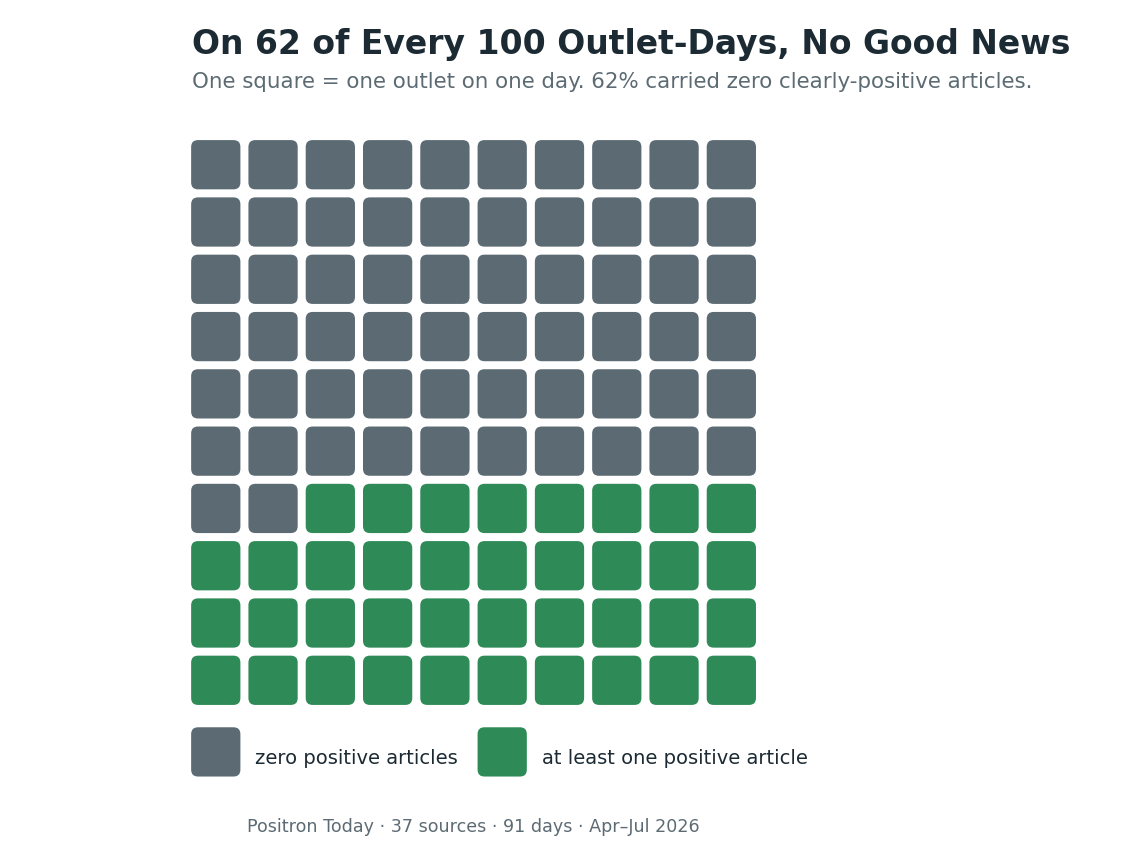
Let me put some numbers on it. Across all our general-news sources - your NRC, your Standaard, your Le Monde, your New York Times - the share of clearly-positive articles hovers somewhere around 1 to 2 percent on an average day. One or two percent. That is the baseline reality of the news.
And then you look at the science publications. Popular Science comes in at around 24 percent positive. Science.org, the news section of the journal Science, sits near 17 percent. Nature is around 15 percent. These are numbers that are ten, fifteen times higher than what the general press manages. They're the closest thing in the mainstream to the dedicated good-news sites.
And here's the thing - it makes complete sense once you stop to think about it. What does science reporting cover? Discovery. A new treatment. A telescope seeing something it's never seen. A material that does a thing we didn't know was possible. Progress, basically. Progress reads as good news, because it is good news.
Now, I have to add one honest caveat, because I'd be a hypocrite otherwise. Not all "tech and science" is created equal. When I split that category in two, something interesting happened. The actual science outlets - the ones reporting on research - scored high. But the consumer-tech news, sites like The Verge that cover the tech industry day to day, scored about half a percent. Half a percent! As gloomy as hard news. Same broad topic, completely opposite mood.
Which tells you something, I think. Reporting on the tech industry - the layoffs, the privacy scandals, the AI-is-going-to-eat-us anxiety - is a fundamentally different thing from reporting on human discovery. One is about companies behaving badly. The other is about people figuring things out. And it turns out only one of those two feels like hope.
I find this genuinely encouraging, and not just as a data point. If you're someone who has more or less given up on the news because it leaves you feeling flat - and honestly, who could blame you - this is a concrete, actionable thing. You don't have to swear off information entirely. You can just steer. Go read about a lab in Ghent, or a trial in Rotterdam, or a rock that came back from an asteroid. The good stuff is out there. It's just filed under "science".
It's also, if I'm honest, a big part of why we built Positron in the first place. We're not trying to hide the hard news - it's real and it matters. But we do think the balance is off, and that there's a whole category of genuinely good, genuinely true stories that get drowned out. The science pages are exhibit A.
Anyway. I'll be digging into more of this data in the coming weeks - there are a couple of other findings that surprised me even more than this one. But I wanted to start here, because it's the one that made me smile.
Go read the science pages. It's the cheeriest corner of the newspaper, and almost nobody tells you that.
Cheers
Rik
Als je goed nieuws wilt lezen, lees dan de wetenschapspagina's
Hier is iets wat ik niet verwacht had.
Een tijdje geleden hebben we een kleine functie aan Positron toegevoegd die we de Positivity Score noemen. Het idee is eenvoudig: elk artikel dat via onze feeds binnenkomt, wordt gelezen door een AI-model, dat het een score van 1 tot 10 geeft op basis van hoe positief het is. Alles vanaf 7 en hoger telt als "duidelijk positief", en dat is het spul dat we echt publiceren. Al het andere wordt transparant geregistreerd, maar haalt het niet.
Nu, zodra je een paar maanden van die scores in een spreadsheet hebt zitten, kun je jezelf niet inhouden. Je begint eraan te prutsen. En ik ben aan het prutsen met 91 dagen aan data van 37 nieuwsbronnen - Belgisch, Brits, Amerikaans, Frans, Duits, Scandinavisch, het volle pond - en één bevinding sprong er meer uit dan alle andere.
De allerbetrouwbaarste bron van goed nieuws in de pers is geen land. Het is geen bepaalde krant. Het is een onderwerp. Het is wetenschap.
Laat me daar wat getallen op zetten. In al onze algemene nieuwsbronnen - je NRC, je Standaard, je Le Monde, je New York Times - schommelt het aandeel duidelijk positieve artikelen rond de 1 tot 2 procent op een gemiddelde dag. Een of twee procent. Dat is de baseline-realiteit van het nieuws.
En dan kijk je naar de wetenschapspublicaties. Popular Science komt uit op ongeveer 24 procent positief. Science.org, de nieuwssectie van het tijdschrift Science, ligt rond de 17 procent. Nature ligt rond de 15 procent. Dit zijn getallen die tien, vijftien keer hoger zijn dan wat de pers in het algemeen bereikt. Ze zijn het dichtst in de mainstream wat goedeniewsbronnen als gemene deler hebben.
En hier is het ding - het is volkomen logisch als je er even over nadenkt. Waarover gaat wetenschapsjournalistiek? Ontdekking. Een nieuwe behandeling. Een telescoop die iets ziet wat hij nog nooit heeft gezien. Een materiaal dat iets kan wat we niet wisten dat mogelijk was. Vooruitgang, eigenlijk. Vooruitgang voelt als goed nieuws, omdat het is goed nieuws.
Nu moet ik eerlijk gezegd één voorbehoud toevoegen, anders zou ik een huichelaar zijn. Niet alle "tech en wetenschap" is gelijk. Toen ik die categorie in tweeën splitste, gebeurde er iets interessants. De echte wetenschap-outlets - de degenen die over onderzoek rapporteren - scoorden hoog. Maar het consumententech-nieuws, sites als The Verge die dagelijks over de tech-industrie berichten, scoorde ongeveer een half procent. Een half procent! Net zo somber als hard nieuws. Hetzelfde brede onderwerp, volkomen tegengestelde stemming.
Wat je iets vertelt, denk ik. Rapportage over de tech-industrie - de ontslagen, de privacyschandalen, de AI-gaat-ons-opeten-angst - is iets fundamenteel anders dan rapportage over menselijke ontdekking. Eén gaat over bedrijven die slecht handelen. Het ander gaat over mensen die dingen uitzoeken. En het blijkt dat slechts één van die twee voelt als hoop.
Ik vind dit echt bemoedigend, en niet alleen als een gegevenspunt. Als je iemand bent die min of meer het geloof in het nieuws verloren hebt omdat het je leeg achterlaat - en eerlijk gezegd, wie zou je dat kwalijk nemen - dan is dit iets concreets en actiefs. Je hoeft niet compleet afscheid te nemen van informatie. Je kunt je gewoon richten. Ga lezen over een lab in Gent, of een proef in Rotterdam, of een rots die van een asteroïde terugkwam. Het goede spul is daar. Het is gewoon ingedeeld onder "wetenschap".
Het is ook, als ik eerlijk ben, een groot deel van de reden waarom we Positron in de eerste plaats hebben gebouwd. We proberen het hard nieuws niet te verbergen - het is echt en het doet er toe. Maar we denken dat de balans verkeerd is, en dat er een heel categorie van echt goed, echt waar verhalen is die wordt overspoeld. De wetenschapspagina's zijn Bewijs A.
Hoe dan ook. Ik zal de komende weken meer in deze data graven - er zijn een paar andere bevindingen die me nog meer hebben verrast dan deze. Maar ik wilde hier beginnen, omdat het degene is die me deed glimlachen.
Lees de wetenschapspagina's. Het is de vrolijkste hoek van de krant, en bijna niemand vertelt je dat.
Groetjes
Rik
Si vous cherchez les bonnes nouvelles, lisez les pages de science
Voilà quelque chose que je n'attendais pas.
Il y a un moment, nous avons ajouté une petite fonctionnalité à Positron que nous avons appelée le Score de Positivité. L'idée est simple : chaque article qui arrive via nos flux est lu par un modèle d'IA, qui lui attribue une note de 1 à 10 selon son degré de positivité. Tout ce qui atteint 7 ou plus compte comme « clairement positif », et c'est ce que nous publions réellement. Tout le reste est enregistré, de manière transparente, mais ne passe pas le cap.
Or, une fois que vous avez quelques mois de ces notes dans une feuille de calcul, vous ne pouvez pas vous en empêcher. Vous commencez à y fouiller. Et j'ai examiné 91 jours de données provenant de 37 sources d'information - belges, britanniques, américaines, françaises, allemandes, scandinaves, le tout - et une découverte s'est détachée plus que toute autre.
La source la plus fiable de bonnes nouvelles dans la presse grand public n'est pas un pays. Ce n'est pas un journal particulier. C'est un sujet. C'est la science.
Laissez-moi vous donner quelques chiffres. Parmi toutes nos sources d'informations générales - votre NRC, votre Standaard, votre Le Monde, votre New York Times - la part d'articles clairement positifs tourne autour de 1 à 2 pour cent en moyenne par jour. Un ou deux pour cent. C'est la réalité de base des informations.
Et puis vous regardez les publications scientifiques. Popular Science arrive à environ 24 pour cent positif. Science.org, la section actualités du journal Science, se situe près de 17 pour cent. Nature est autour de 15 pour cent. Ce sont des chiffres qui sont dix, quinze fois plus élevés que ce que la presse générale parvient à atteindre. C'est ce qui se rapproche le plus dans la presse grand public des sites dédiés aux bonnes nouvelles.
Et voilà le truc - c'est parfaitement logique une fois qu'on y réfléchit. Qu'est-ce que le reportage scientifique couvre ? La découverte. Un nouveau traitement. Un télescope qui voit quelque chose qu'il n'a jamais vu. Un matériau qui fait quelque chose que nous ne savions pas possible. Le progrès, essentiellement. Le progrès se lit comme une bonne nouvelle, parce que c'est une bonne nouvelle.
Maintenant, je dois ajouter une caverne honnête, parce que je serais un hypocrite sinon. Pas toute la « technologie et science » n'est égale. Quand j'ai divisé cette catégorie en deux, quelque chose d'intéressant s'est produit. Les vrais débouchés de science - ceux qui rapportent sur la recherche - ont obtenu des scores élevés. Mais les actualités technologiques grand public, des sites comme The Verge qui couvrent l'industrie tech au quotidien, ont obtenu environ un demi pour cent. Un demi pour cent ! Aussi morose que les informations dures. Le même sujet général, une ambiance complètement opposée.
Ce qui vous dit quelque chose, je pense. Rapporter sur l'industrie tech - les licenciements, les scandales de confidentialité, l'anxiété « l'IA va nous dévorer » - est une chose fondamentalement différente de rapporter sur la découverte humaine. L'un porte sur le mauvais comportement des entreprises. L'autre porte sur les gens qui découvrent des choses. Et il s'avère que seulement l'un des deux ressemble à de l'espoir.
Je trouve cela véritablement encourageant, et pas seulement comme point de données. Si vous êtes quelqu'un qui a plus ou moins renoncé aux informations parce qu'elles vous laissent vous sentir mal - et honnêtement, qui pourrait vous le reprocher - c'est quelque chose de concret et d'actionnable. Vous n'avez pas besoin de renoncer complètement à l'information. Vous pouvez simplement naviguer. Allez lire sur un laboratoire à Gand, ou un essai à Rotterdam, ou un rocher qui est revenu d'un astéroïde. Les bonnes choses sont là. C'est juste rangé sous « science ».
C'est aussi, pour être honnête, une grande partie de la raison pour laquelle nous avons construit Positron en premier lieu. Nous ne cherchons pas à cacher les informations difficiles - elles sont réelles et elles comptent. Mais nous pensons que l'équilibre est mauvais, et qu'il existe toute une catégorie d'histoires véritablement bonnes et véritablement vraies qui sont noyées. Les pages de science en sont la preuve par excellence.
Bref. Je vais fouiller davantage dans ces données dans les semaines à venir - il y a un couple d'autres découvertes qui m'ont encore plus surpris que celle-ci. Mais j'ai voulu commencer ici, parce que c'est celle qui m'a fait sourire.
Allez lire les pages de science. C'est le coin le plus joyeux du journal, et presque personne ne vous le dit.
Cordialement
Rik