Loss aversion and the news: why uncertainty makes us crave catastrophe
A few years ago, during one of those genuinely uncertain stretches we've all lived through lately, I caught myself doing something slightly ridiculous. It was late, everyone in the house was asleep, and I was lying in bed refreshing the news. Not because anything had happened. Not because there was anything I could do at midnight in Antwerp about the state of the world. I was just... refreshing. Scanning for the next bad thing. And here's the part that actually bothered me the next morning: it hadn't made me feel better. It had made me feel worse. And I'd known, the whole time, that it would.
Why on earth do we do that?
I think the best answer I've ever found comes from two psychologists whose work I genuinely love, and whose ideas sit right at the heart of why I built Positron. So let me tell you about Daniel Kahneman and Amos Tversky, and a beautiful, slightly unsettling idea called prospect theory.
The most important graph you've never seen
In 1979, Kahneman and Tversky published a paper in the economics journal Econometrica called "Prospect Theory: An Analysis of Decision under Risk". It went on to become one of the most cited papers in all of social science, and it eventually won Kahneman a Nobel Prize in economics - which is quite something for a psychologist who, by his own cheerful admission, never took a single economics course.
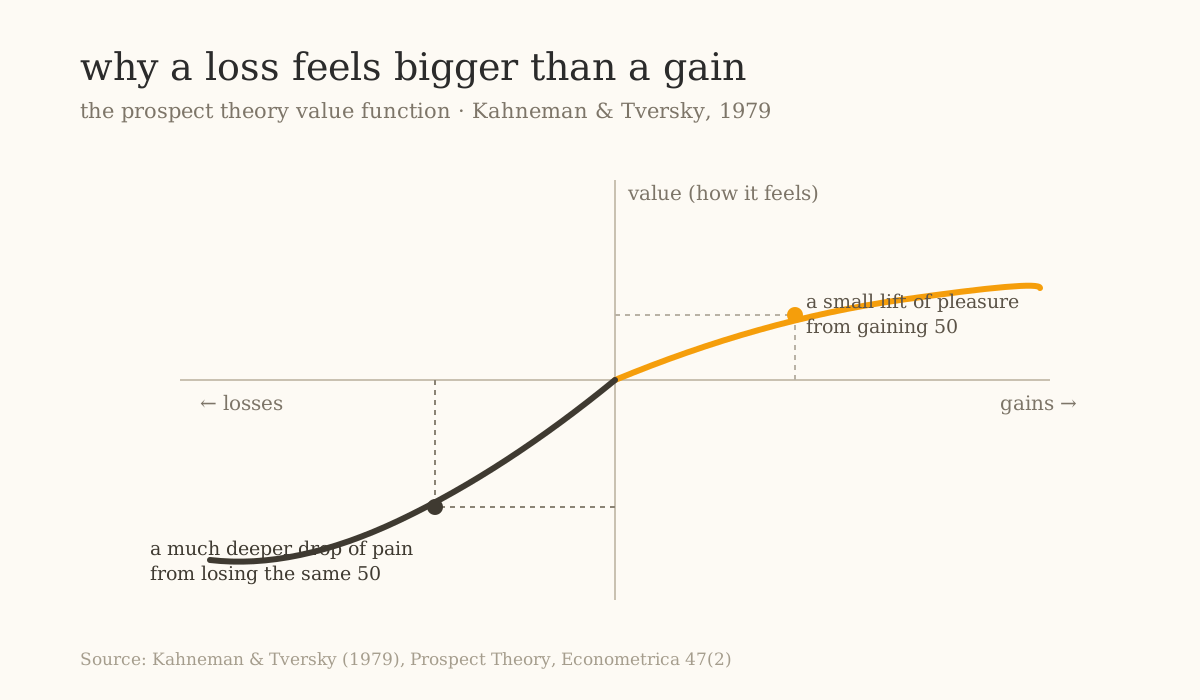
The core of it can be drawn as a single curve, and it's the image at the top of this article. Up until then, economists had mostly assumed we treat gains and losses symmetrically - that finding 50 euros and losing 50 euros are simply mirror images, equal and opposite. Kahneman and Tversky showed, experiment after experiment, that this is just not how humans actually work.
Look at the curve. The bottom half - the losses - is much steeper than the top half. That steepness is the whole point. It means a loss of a given size feels substantially bigger than a gain of exactly the same size. The pain of losing 50 euros is sharper than the pleasure of winning it. Most estimates put the difference at somewhere around twice as strong. We are, in the jargon, loss averse.
Overvaluing costs, undervaluing benefits
Now, here's where it connects to something you already sensed. Kahneman and Tversky also showed that we tend to overweight small probabilities of dramatic events. A tiny chance of a catastrophe looms far larger in the mind than its actual likelihood warrants. Put loss aversion and this quirk together and you get a very particular kind of animal: one that systematically overvalues potential costs and undervalues potential benefits, especially when things feel uncertain.
Which, if you think about it, is a near-perfect description of how it feels to be alive right now. And it's also - and this is the bit I find fascinating - a near-perfect description of the market the news industry is serving.
If our minds are wired to treat threats as bigger, closer, and more urgent than opportunities of the same size, then a headline about something going wrong is simply better tuned to the human brain than a headline about something going right. It's not that editors are villains. It's that a threat-shaped story fits a threat-shaped mind like a key in a lock. "Bad news sells" isn't a cynical newsroom slogan. It's loss aversion, dressed up as a business model.
But surely people say they want good news?
Here's the objection I hear all the time, and it's a fair one. If bad news is so unpleasant, why don't people just... choose the good stuff? Ask almost anyone and they'll tell you they're sick of the doom and gloom, that they'd love more positive news. I hear it constantly. I felt it myself, refreshing that phone at midnight.
The trouble is that what we say and what we do turn out to be two very different things.
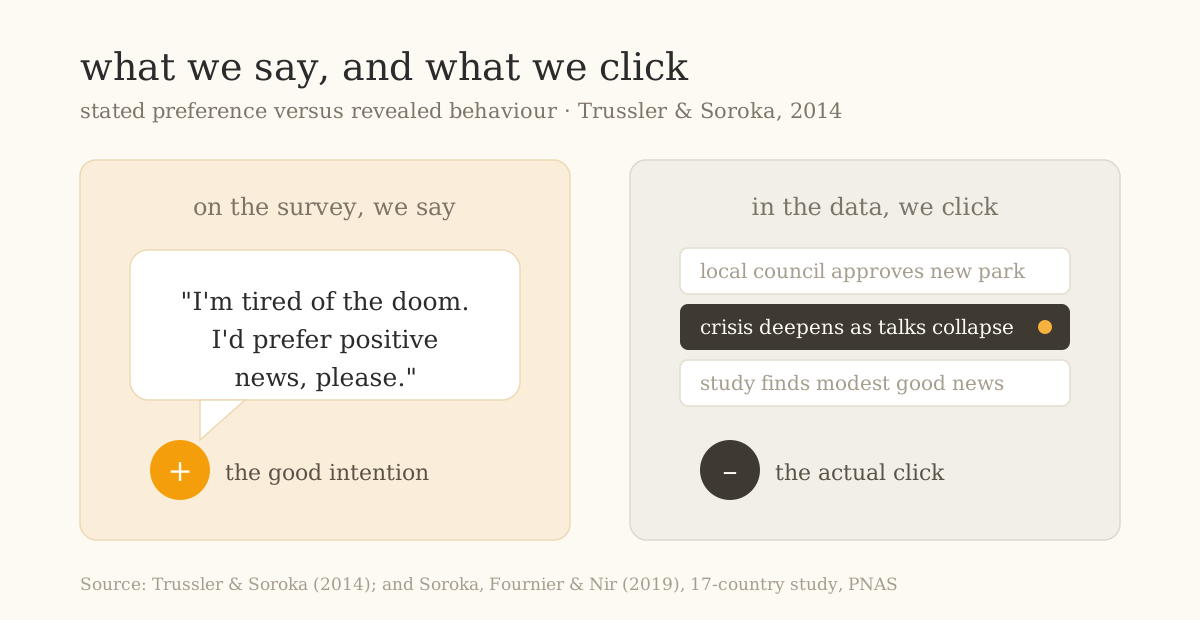
There's a clever study by Marc Trussler and Stuart Soroka from 2014 that gets right at this. They brought people into a lab under the cover story that they were testing eye-tracking equipment, and simply let them pick news stories to read while they waited. People reliably gravitated toward the negative stories - even the ones who had told the researchers, moments earlier on a survey, that they preferred positive news and thought the media was too negative. What we click and what we claim are not the same. The polite survey answer is "I want good news." The revealed preference, measured by actual behaviour, leans the other way.
And this is not just a quirk of one lab in one country. In 2019, Soroka, together with Patrick Fournier and Lilach Nir, ran a remarkable study across seventeen countries on six continents. They wired people up - measuring skin conductance and heart rate, the body's honest little tells - and showed them real news clips. On average, all around the world, people were more physiologically aroused by negative news than by positive news. Different cultures, different languages, different media systems, same basic bodily response. The pull toward the negative isn't a Western media disease. It looks like part of the human operating system.
The trap, and the way out
So put the whole picture together. We overweight losses. We overweight small chances of catastrophe. We physically react more to bad news than good. And so, without anyone needing to conspire, we build a media ecosystem that feeds us exactly what our anxious wiring reaches for - and then we lie in bed at midnight, refreshing, feeling worse, and doing it anyway.
That sounds bleak. But I actually think there's something quietly liberating in understanding it. Because once you know that the pull is automatic - once you can name it as loss aversion rather than as a true and balanced picture of the world - you can start to treat it as something to be managed rather than obeyed. The midnight refresh isn't news-gathering. It's a reflex. And reflexes can be interrupted.
That's really all Positron is, when you get down to it. It's a small, deliberate interruption. A way of choosing, on purpose, to let some good news through the filter that your own psychology - and the entire attention economy built on top of it - is quietly tuned to block. Not to pretend the losses aren't real. Just to stop letting them be the only thing you ever see.
Kahneman, sadly, is no longer with us, and Tversky died back in 1996. But I think they'd appreciate the irony of it: understanding exactly how our minds tilt toward the negative is the first real step to gently tilting back.
In the next article I want to look at what happened when this very human wiring met the machines - because social media algorithms didn't invent our negativity bias, but they may just have poured rocket fuel on it.
Cheers / Rik
Verliesaversie en het nieuws: waarom onzekerheid ons doet hunkeren naar catastrofe
Een paar jaar geleden, tijdens een van die oprecht onzekere periodes die we allemaal recent hebben meegemaakt, betrapte ik mezelf op iets licht ridicuuls. Het was laat, iedereen in huis sliep, en ik lag in bed de nieuwsberichten te verversen. Niet omdat er iets gebeurd was. Niet omdat er iets was dat ik om middernacht in Antwerpen kon doen aan de staat van de wereld. Ik was gewoon... aan het verversen. Scannen naar het volgende slechte nieuws. En hier is het gedeelte dat me de volgende ochtend echt dwarszat: het had me niet beter laten voelen. Het had me slechter laten voelen. En ik had de hele tijd geweten dat het zo zou zijn.
Waarom in hemelsnaam doen we dat?
Ik denk dat het beste antwoord dat ik ooit heb gevonden afkomstig is van twee psychologen wiens werk ik oprecht bewonder, en wiens ideeën precies in het hart zitten van waarom ik Positron heb gebouwd. Laat me je vertellen over Daniel Kahneman en Amos Tversky, en een prachtig, iets verontrustend idee dat prospecttheorie wordt genoemd.
De belangrijkste grafiek die je nooit hebt gezien
In 1979 publiceerden Kahneman en Tversky een paper in het economisch tijdschrift Econometrica genaamd "Prospect Theory: An Analysis of Decision under Risk". Het werd een van de meest geciteerde artikelen in de sociale wetenschappen en het leverde Kahneman uiteindelijk een Nobelprijs voor de economie op - wat behoorlijk bijzonder is voor een psycholoog die, zoals hij zelf vrolijk toegeeft, nooit een enkele cursus economie heeft gevolgd.
De kern ervan kan worden getekend als een enkele curve, en het is de afbeelding bovenaan dit artikel. Tot dat moment gingen economen er meestal van uit dat we winsten en verliezen symmetrisch behandelen - dat het vinden van 50 euro en het verliezen van 50 euro gewoon spiegelbeelden zijn, gelijk en tegengesteld. Kahneman en Tversky toonden, experiment na experiment, aan dat dit gewoon niet is hoe mensen daadwerkelijk functioneren.
Kijk naar de curve. De onderste helft - de verliezen - is veel steiler dan de bovenste helft. Die steilheid is het hele punt. Het betekent dat een verlies van een bepaalde grootte veel groter aanvoelt dan een winst van precies dezelfde grootte. De pijn van het verliezen van 50 euro is scherper dan het plezier van het winnen ervan. De meeste schattingen plaatsen het verschil rond de twee keer zo sterk. We zijn, in de jargon, verliesavers.
Kosten overwaarderen, voordelen onderwaarderen
Nu, hier is waar het aansluit bij iets dat je al voelde. Kahneman en Tversky toonden ook aan dat we de kleine waarschijnlijkheden van dramatische gebeurtenissen overwaarderen. Een kleine kans op een catastrofe lijkt in de geest veel groter dan de werkelijke waarschijnlijkheid rechtvaardigt. Zet verliesaversie en deze eigenaardigheid bij elkaar en je krijgt een heel bijzonder soort dier: eentje die systematisch potentiële kosten overwaardeert en potentiële voordelen onderwaardeert, vooral wanneer dingen onzeker aanvoelen.
Wat, als je erover nadenkt, een bijna perfecte beschrijving is van hoe het voelt om nu in leven te zijn. En het is ook - en dit is het gedeelte dat ik fascinerend vind - een bijna perfecte beschrijving van de markt die de nieuwsindustrie bedient.
Als onze geesten zijn ingesteld om bedreigingen als groter, dichterbij en urgenter te beschouwen dan kansen van dezelfde grootte, dan is een kop over iets dat misgaat gewoon beter afgestemd op de menselijke geest dan een kop over iets dat goed gaat. Het is niet dat redacteuren schurken zijn. Het is dat een bedreiging-vormig verhaal past in een bedreiging-vormige geest als een sleutel in een slot. "Slecht nieuws verkoopt" is geen cynische slogan in de redactiekamer. Het is verliesaversie, verkleed als een businessmodel.
Maar mensen zeggen toch dat ze goed nieuws willen?
Hier is de tegenwerping die ik de hele tijd hoor, en het is een eerlijke. Als slecht nieuws zo onaangenaam is, waarom kiezen mensen dan niet gewoon... voor het goede nieuws? Vraag bijna iedereen en ze zullen je vertellen dat ze genoeg hebben van de doem en gloom, dat ze meer positief nieuws zouden willen. Ik hoor het constant. Ik voelde het zelf, terwijl ik die telefoon om middernacht verversde.
Het probleem is dat wat we zeggen en wat we doen twee heel verschillende dingen blijken te zijn.
Er is een slimme studie van Marc Trussler en Stuart Soroka uit 2014 die hier precies op ingaat. Ze brachten mensen naar een lab onder het voorwendsel dat ze oogvolgapparatuur testten, en lieten ze simpelweg nieuwsverhalen kiezen om te lezen terwijl ze wachtten. Mensen neigden betrouwbaar naar de negatieve verhalen - zelfs degenen die de onderzoekers, enkele momenten eerder in een enquête, hadden verteld dat ze de voorkeur gaven aan positief nieuws en dachten dat de media te negatief was. Wat we klikken en wat we beweren zijn niet hetzelfde. Het beleefde enquêteantwoord is "Ik wil goed nieuws." De onthulde voorkeur, gemeten door daadwerkelijk gedrag, leunt de andere kant op.
En dit is niet alleen een eigenaardigheid van één lab in één land. In 2019 voerden Soroka, samen met Patrick Fournier en Lilach Nir, een opmerkelijke studie uit in zeventien landen op zes continenten. Ze verbonden mensen - meetend huidgeleiding en hartslag, de eerlijke kleine signalen van het lichaam - en toonden hen echte nieuwsfragmenten. Gemiddeld, over de hele wereld, waren mensen fysiologisch meer opgewonden door negatief nieuws dan door positief nieuws. Verschillende culturen, verschillende talen, verschillende mediasystemen, dezelfde basis lichamelijke reactie. De aantrekkingskracht van het negatieve is geen Westers mediaprobleem. Het lijkt een onderdeel van het menselijke besturingssysteem te zijn.
De val, en de weg eruit
Dus zet het hele plaatje bij elkaar. We overwaarderen verliezen. We overwaarderen kleine kansen op catastrofe. We reageren fysiek meer op slecht nieuws dan op goed nieuws. En dus, zonder dat iemand hoeft te samenzweren, bouwen we een media-ecosysteem dat ons precies geeft waar onze angstige wiring naar hunkert - en dan liggen we om middernacht in bed, verversen, ons slechter voelen, en doen het toch.
Dat klinkt somber. Maar ik denk eigenlijk dat er iets stilletjes bevrijdends is in het begrijpen ervan. Want zodra je weet dat de aantrekkingskracht automatisch is - zodra je het kunt benoemen als verliesaversie in plaats van als een waar en gebalanceerd beeld van de wereld - kun je beginnen het te behandelen als iets dat beheerd moet worden in plaats van gehoorzaamd. Het middernacht verversen is geen nieuwsverzameling. Het is een reflex. En reflexen kunnen worden onderbroken.
Dat is eigenlijk alles wat Positron is, als je erover nadenkt. Het is een kleine, opzettelijke onderbreking. Een manier om opzettelijk te kiezen om wat goed nieuws door de filter te laten die jouw eigen psychologie - en de hele aandachtseconomie die daarbovenop is gebouwd - stilletjes is afgestemd om te blokkeren. Niet om te doen alsof de verliezen niet echt zijn. Gewoon om te stoppen met het laten zijn van het enige dat je ooit ziet.
Kahneman is, helaas, niet meer bij ons, en Tversky stierf in 1996. Maar ik denk dat ze de ironie ervan zouden waarderen: precies begrijpen hoe onze geesten naar het negatieve hellen is de eerste echte stap om voorzichtig weer terug te hellen.
In het volgende artikel wil ik kijken naar wat er gebeurde toen deze zeer menselijke wiring de machines ontmoette - omdat sociale media-algoritmen onze negativiteitsbias niet hebben uitgevonden, maar ze hebben het misschien gewoon een raketbrandstof gegeven.
Proost / Rik
L'aversion à la perte et les nouvelles : pourquoi l'incertitude nous pousse à désirer la catastrophe
Il y a quelques années, pendant l'une de ces périodes véritablement incertaines que nous avons tous vécues récemment, je me suis surpris à faire quelque chose de légèrement ridicule. Il était tard, tout le monde dans la maison dormait, et j'étais allongé dans mon lit à rafraîchir les nouvelles. Pas parce que quelque chose s'était passé. Pas parce qu'il y avait quoi que ce soit que je pouvais faire à minuit à Anvers concernant l'état du monde. Je faisais juste... rafraîchir. Scanner à la recherche de la prochaine mauvaise nouvelle. Et voici la partie qui m'a réellement dérangé le lendemain matin : cela ne m'avait pas fait me sentir mieux. Cela m'avait fait me sentir pire. Et j'avais su, tout ce temps, que cela arriverait.
Pourquoi diable faisons-nous cela ?
Je pense que la meilleure réponse que j'ai jamais trouvée vient de deux psychologues dont j'adore vraiment le travail, et dont les idées se trouvent au cœur même de la raison pour laquelle j'ai construit Positron. Alors laissez-moi vous parler de Daniel Kahneman et Amos Tversky, et d'une idée belle et légèrement troublante appelée la théorie des perspectives.
Le graphique le plus important que vous n'avez jamais vu
En 1979, Kahneman et Tversky ont publié un article dans la revue économique Econometrica intitulé "Théorie des perspectives : une analyse de la décision sous risque". Cet article est devenu l'un des plus cités dans toutes les sciences sociales, et il a finalement valu à Kahneman un prix Nobel d'économie - ce qui est assez remarquable pour un psychologue qui, de son propre aveu joyeux, n'a jamais suivi un seul cours d'économie.
Son essence peut être représentée par une seule courbe, et c'est l'image en haut de cet article. Jusqu'alors, les économistes avaient principalement supposé que nous traitions les gains et les pertes de manière symétrique - que trouver 50 euros et perdre 50 euros sont simplement des images miroir, égales et opposées. Kahneman et Tversky ont montré, expérience après expérience, que ce n'est tout simplement pas ainsi que les humains fonctionnent réellement.
Regardez la courbe. La moitié inférieure - les pertes - est beaucoup plus raide que la moitié supérieure. Cette raideur est tout l'enjeu. Cela signifie qu'une perte d'une certaine taille semble substantiellement plus grande qu'un gain de la même taille. La douleur de perdre 50 euros est plus aiguë que le plaisir de les gagner. La plupart des estimations placent la différence à environ deux fois plus forte. Nous sommes, dans le jargon, aversion à la perte.
Surestimer les coûts, sous-estimer les bénéfices
Maintenant, voici où cela se connecte à quelque chose que vous avez déjà pressenti. Kahneman et Tversky ont également montré que nous avons tendance à sous-estimer les petites probabilités d'événements dramatiques. Une petite chance de catastrophe pèse beaucoup plus lourd dans l'esprit que sa probabilité réelle ne le justifie. Mettez ensemble l'aversion à la perte et cette particularité et vous obtenez un type d'animal très particulier : celui qui surestime systématiquement les coûts potentiels et sous-estime les bénéfices potentiels, surtout lorsque les choses semblent incertaines.
Ce qui, si vous y réfléchissez, est une description presque parfaite de ce que cela fait d'être en vie en ce moment. Et c'est aussi - et c'est la partie que je trouve fascinante - une description presque parfaite du marché que l'industrie de l'information sert.
Si nos esprits sont câblés pour traiter les menaces comme étant plus grandes, plus proches et plus urgentes que les opportunités de même taille, alors un titre sur quelque chose qui tourne mal est simplement mieux accordé au cerveau humain qu'un titre sur quelque chose qui va bien. Ce n'est pas que les rédacteurs soient des méchants. C'est qu'une histoire en forme de menace s'adapte à un esprit en forme de menace comme une clé dans une serrure. "Les mauvaises nouvelles se vendent" n'est pas un slogan cynique de salle de rédaction. C'est l'aversion à la perte, déguisée en modèle économique.
Mais les gens disent sûrement qu'ils veulent de bonnes nouvelles ?
Voici l'objection que j'entends tout le temps, et c'est une objection valable. Si les mauvaises nouvelles sont si désagréables, pourquoi les gens ne choisissent-ils pas simplement... les bonnes choses ? Demandez presque à quiconque et il vous dira qu'il en a marre du catastrophisme, qu'il aimerait plus de nouvelles positives. Je l'entends constamment. Je l'ai ressenti moi-même, en rafraîchissant ce téléphone à minuit.
Le problème est que ce que nous disons et ce que nous faisons s'avèrent être deux choses très différentes.
Il y a une étude astucieuse de Marc Trussler et Stuart Soroka de 2014 qui touche exactement à cela. Ils ont amené des gens dans un laboratoire sous le prétexte qu'ils testaient un équipement de suivi oculaire, et les ont simplement laissés choisir des histoires d'actualités à lire pendant qu'ils attendaient. Les gens se sont systématiquement dirigés vers les histoires négatives - même ceux qui avaient dit aux chercheurs, quelques instants plus tôt lors d'une enquête, qu'ils préféraient les bonnes nouvelles et pensaient que les médias étaient trop négatifs. Ce que nous cliquons et ce que nous affirmons ne sont pas les mêmes. La réponse polie à l'enquête est "Je veux de bonnes nouvelles." La préférence révélée, mesurée par le comportement réel, penche dans l'autre sens.
Et ce n'est pas juste une particularité d'un laboratoire dans un pays. En 2019, Soroka, avec Patrick Fournier et Lilach Nir, a mené une étude remarquable dans dix-sept pays sur six continents. Ils ont connecté des gens - mesurant la conductance de la peau et le rythme cardiaque, les petits signes honnêtes du corps - et leur ont montré de vrais extraits d'actualités. En moyenne, dans le monde entier, les gens étaient physiologiquement plus stimulés par les nouvelles négatives que par les nouvelles positives. Différentes cultures, différentes langues, différents systèmes médiatiques, même réponse corporelle de base. L'attraction vers le négatif n'est pas une maladie des médias occidentaux. Cela semble faire partie du système d'exploitation humain.
Le piège, et le moyen de sortir
Alors mettez l'ensemble du tableau ensemble. Nous surestimons les pertes. Nous surestimons les petites chances de catastrophe. Nous réagissons physiquement plus aux mauvaises nouvelles qu'aux bonnes. Et donc, sans que quiconque ait besoin de conspirer, nous construisons un écosystème médiatique qui nous nourrit exactement de ce que notre câblage anxieux recherche - et puis nous restons allongés dans notre lit à minuit, à rafraîchir, à nous sentir pires, et à le faire quand même.
Cela semble sombre. Mais je pense en réalité qu'il y a quelque chose de discrètement libérateur à le comprendre. Parce qu'une fois que vous savez que cette attraction est automatique - une fois que vous pouvez la nommer comme aversion à la perte plutôt que comme une image vraie et équilibrée du monde - vous pouvez commencer à la traiter comme quelque chose à gérer plutôt qu'à obéir. Le rafraîchissement de minuit n'est pas une collecte d'informations. C'est un réflexe. Et les réflexes peuvent être interrompus.
C'est vraiment tout ce qu'est Positron, quand on y pense. C'est une petite interruption délibérée. Une façon de choisir, intentionnellement, de laisser passer quelques bonnes nouvelles à travers le filtre que votre propre psychologie - et toute l'économie de l'attention construite dessus - est discrètement réglée pour bloquer. Pas pour prétendre que les pertes ne sont pas réelles. Juste pour arrêter de laisser cela être la seule chose que vous voyez jamais.
Kahneman, hélas, n'est plus parmi nous, et Tversky est décédé en 1996. Mais je pense qu'ils apprécieraient l'ironie : comprendre exactement comment nos esprits penchent vers le négatif est le premier véritable pas pour pencher doucement en arrière.
Dans le prochain article, je veux examiner ce qui s'est passé lorsque ce câblage humain a rencontré les machines - car les algorithmes des médias sociaux n'ont pas inventé notre biais négatif, mais ils ont peut-être juste mis du carburant-fusée dessus.
À bientôt / Rik