The lazy brain and the bad news
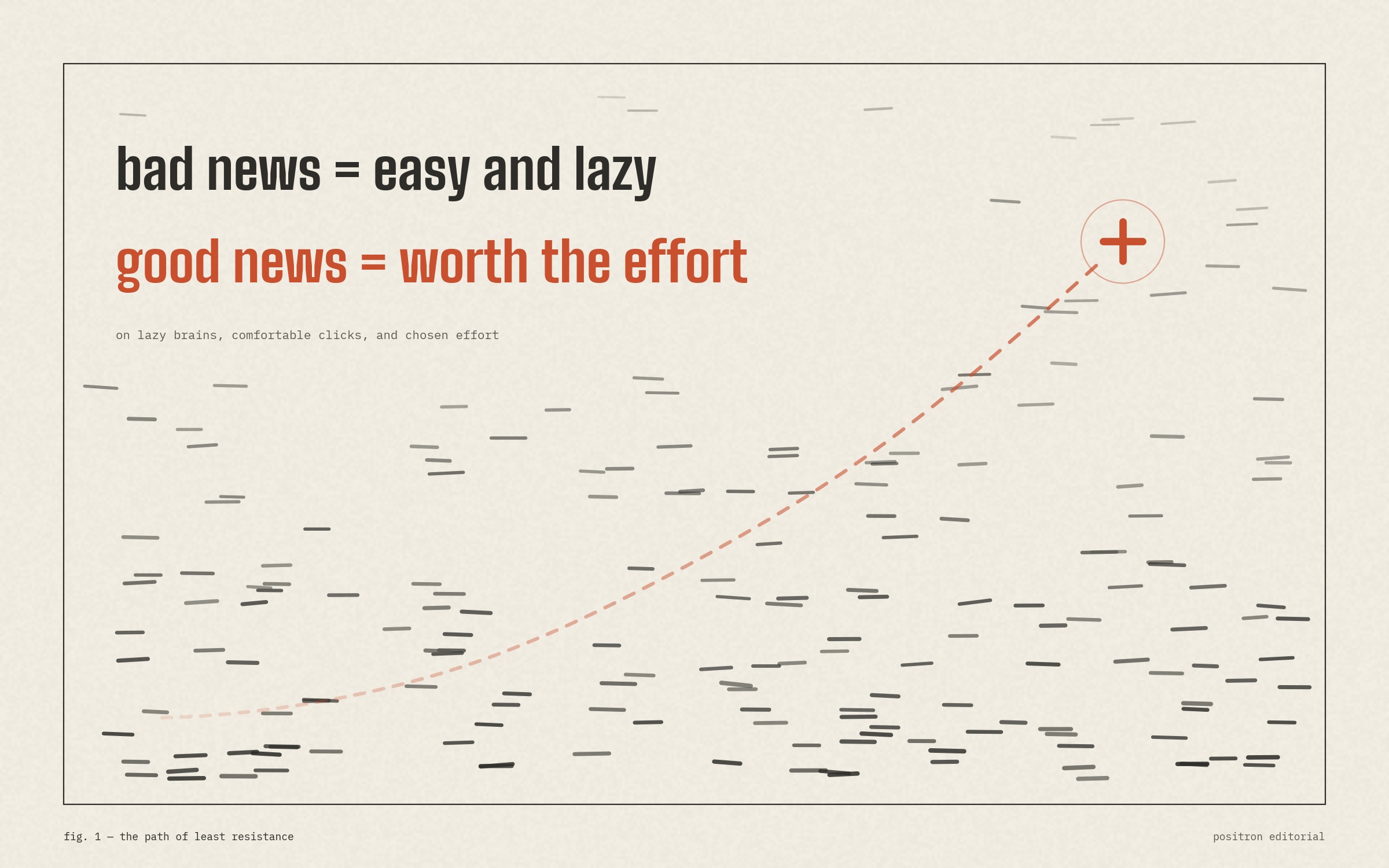
A couple of weeks ago, I was mulling over something that seemed like a proper contradiction to me. In earlier editorials, we have written about the fact that people seem to actively seek out negative news - the doom, the gloom, the outrage. That's well documented, and it's one of the reasons why Positron exists in the first place. But at the same time, I kept bumping into another truth that seemed to point in exactly the opposite direction: people are, let's be honest, quite lazy. We optimise for convenience and pleasure. We take the elevator, not the stairs. We order in, we swipe, we binge. Humankind is a comfort-seeking species if there ever was one.
So how do you square those two things? If we are all pleasure-seeking creatures of comfort, why on earth would we voluntarily wade into a river of misery every morning before breakfast? Surely a lazy, pleasure-seeking brain would choose the good news?
That question kept nagging at me. And here's the thing: the more I dug into it, the more I realised that the contradiction is not a contradiction at all. In fact, the second truth explains the first one. Let me try to unpack that.
First truth: we really do prefer the bad stuff
The evidence here is quite overwhelming. Stuart Soroka and his colleagues measured people's physiological reactions to news in 17 countries across 6 continents, and found that humans everywhere react more strongly to negative news than to positive news. And it's not just how we react - it's what we click on. A team of researchers analysed about 105,000 headline variations from Upworthy, covering some 370 million impressions, and found that every additional negative word in a headline increased the click-through rate by 2.3%. Positive words actually decreased clicks. Bad news sells, quite literally.
Second truth: we really are lazy
Also well documented. Psychologists call it the "law of least mental effort": when given the choice, our brains systematically pick the option that requires the least cognitive work. Wouter Kool and his colleagues showed this in a series of six experiments - people reliably avoided the more demanding tasks, and remarkably, they did so without even being aware of it. We don't decide to be lazy. We just are. Our brains are metabolic misers, always looking for the discount.
The reconciliation: negativity is the lazy option
So here is where it clicked for me. My mistake - and I suspect many people make it - was to assume that consuming negative news is somehow the "hard" choice, and that pleasure would be the "easy" one. It's exactly the other way around.
Negativity bias is not a preference in any meaningful sense. It's a reflex. Psychologists have called it "automatic vigilance": threatening information grabs our attention before we've had any chance to think about it. It's an ancient alarm system, and it runs for free. No effort required. The sabre-toothed tiger did not wait for us to finish our nuanced reflection.
Hope, on the other hand, is expensive. Nuance is expensive. Looking at a complicated world and asking "what's actually getting better here, and why?" - that requires exactly the kind of effortful, controlled thinking that our lazy brains are wired to avoid.
And there's a cruel little twist on top of that. Neuroscientists distinguish between "wanting" and "liking" - the craving circuit and the pleasure circuit are two different things in the brain. Doomscrolling is pure wanting without any liking. We don't enjoy the bad news - study after study shows that compulsive negative news consumption makes us feel demonstrably worse. We keep scrolling anyway. So no, we are not pleasure-seeking when we drown ourselves in negativity. We are being pulled along by a craving machine that never actually pays out.
Add to that what Tim Wu called the tyranny of convenience: entire industries are built on serving us the frictionless option. And the frictionless option for capturing human attention is, as we now know, fear and outrage. The media did not create our negativity bias - but they have industrialised it.
The good news about discomfort
Now, here's where it gets interesting. Because you could read all of the above and conclude that we are simply stuck - lazy brains, lazy clicks, lazy world. But there is a growing body of evidence saying that a bit of discomfort is not just tolerable. It's actually good for us.
Biologists call it hormesis: the phenomenon where a mild dose of a stressor - exercise, fasting, heat, cold - triggers repair and adaptation mechanisms that leave us stronger than before. Mark Mattson, one of the leading researchers in this field, literally titled one of his papers "Challenging Oneself Intermittently to Improve Health". Intermittent fasting, as he and Rafael de Cabo summarised in the New England Journal of Medicine, activates deep cellular stress responses that improve insulin sensitivity and resilience. Exercise - which is, let's face it, voluntary discomfort - boosts BDNF in the brain and keeps our neurons young. Our bodies were built for challenge, and they quietly deteriorate without it.
And it's not just our bodies. Kaitlin Woolley and Ayelet Fishbach ran five experiments with over 2,000 people and found that when people deliberately seek out discomfort - rather than merely tolerating it - they grow more, persist longer, and, tellingly, open themselves up more to challenging but important information. Read that last bit again. The willingness to be uncomfortable is precisely what makes us better informed.
So the comfortable option is a double trap. It hands our attention to the outrage machine, and it slowly softens our bodies and minds. A little chosen discomfort, it turns out, is one of the healthiest things we can do.
So what does that mean for us?
It means, I think, that positivity is not naive. It's effortful - and that effort is not a bug, it's the feature. Choosing to look at what goes well in the world, at progress, at solutions - that is the stairs, not the elevator. It's a deliberate act of swimming against your own neurological current. And just like the stairs, it's exactly the kind of mild, chosen discomfort that makes us stronger.
And that, to me, is quite a hopeful reconciliation. Because effort is a choice. We can't switch off our ancient alarm systems, but we can decide - consciously, deliberately, a little bit stubbornly - where to point our attention once the alarm has sounded. That is what we are trying to do here at Positron. Not feel-good news for people who want to look away, but real news for people who are willing to do a little bit of work.
The lazy brain will always click on the bad news. The question is whether we are more than our lazy brains. I'd like to think that we are.
Hope this was a useful reflection - as always, would love to hear what you think.
Cheers
Rik
De luie hersenen en het slechte nieuws
Een paar weken geleden zat ik te broeden op iets dat voor mij als een echte tegenstrijdigheid leek. In eerdere editorials hebben we geschreven over het feit dat mensen schijnbaar actief op zoek gaan naar negatief nieuws - de ondergang, de somberheid, de verontwaardiging. Dat is goed gedocumenteerd, en het is een van de redenen waarom Positron überhaupt bestaat. Maar tegelijkertijd bleef ik stuiten op een andere waarheid die precies in de tegenovergestelde richting leek te wijzen: mensen zijn, laten we eerlijk zijn, behoorlijk lui. We optimaliseren voor gemak en genot. We nemen de lift, niet de trap. We bestellen eten, we swipen, we binge-watchen. De mensheid is een soort die op zoek is naar comfort, als er ooit een was.
Dus hoe verzoen je die twee dingen? Als we allemaal genotszuchtige wezens van comfort zijn, waarom zouden we dan in hemelsnaam vrijwillig elke ochtend voor het ontbijt door een rivier van ellende waden? Zeker, een luie, genotszuchtige hersenen zou voor het goede nieuws kiezen?
Die vraag bleef aan me knagen. En hier is het punt: hoe dieper ik erin groef, hoe meer ik me realiseerde dat de tegenstrijdigheid helemaal geen tegenstrijdigheid is. Sterker nog, de tweede waarheid verklaart de eerste. Laat me proberen dat uit te leggen.
Eerste waarheid: we geven echt de voorkeur aan het slechte nieuws
Het bewijs hiervoor is behoorlijk overweldigend. Stuart Soroka en zijn collega's maten de fysiologische reacties van mensen op nieuws in 17 landen over 6 continenten en ontdekten dat mensen overal sterker reageren op negatief nieuws dan op positief nieuws. En het gaat niet alleen om hoe we reageren - het gaat ook om wat we aanklikken. Een team van onderzoekers analyseerde ongeveer 105.000 variaties van koppen van Upworthy, die zo'n 370 miljoen impressies dekte, en ontdekte dat elk extra negatief woord in een kop de doorklikratio met 2,3% verhoogde. Positieve woorden verminderden zelfs daadwerkelijk het aantal klikken. Slecht nieuws verkoopt, letterlijk.
Tweede waarheid: we zijn echt lui
Ook goed gedocumenteerd. Psychologen noemen het de "wet van de minste mentale inspanning": wanneer we de keuze hebben, kiezen onze hersenen systematisch de optie die de minste cognitieve inspanning vereist. Wouter Kool en zijn collega's toonden dit aan in een serie van zes experimenten - mensen vermeden betrouwbaar de meer veeleisende taken, en opmerkelijk genoeg deden ze dat zonder zich er zelfs maar van bewust te zijn. We besluiten niet om lui te zijn. We zijn het gewoon. Onze hersenen zijn metabolische gierigaards, altijd op zoek naar de korting.
De verzoening: negativiteit is de luie optie
Dus hier is waar het voor mij klikte. Mijn fout - en ik vermoed dat veel mensen die maken - was aan te nemen dat het consumeren van negatief nieuws op de een of andere manier de "moeilijke" keuze is, en dat genot de "gemakkelijke" zou zijn. Het is precies het tegenovergestelde.
Negativiteitsbias is geen voorkeur in enige betekenisvolle zin. Het is een reflex. Psychologen hebben het "automatische waakzaamheid" genoemd: bedreigende informatie trekt onze aandacht voordat we ook maar de kans hebben gehad om erover na te denken. Het is een oud alarmsysteem, en het draait gratis. Geen inspanning vereist. De sabeltandtijger wachtte niet tot we onze genuanceerde reflectie hadden afgerond.
Hoop, aan de andere kant, is duur. Nuance is duur. Kijken naar een gecompliceerde wereld en vragen "wat verbetert hier eigenlijk, en waarom?" - dat vereist precies het soort inspannend, gecontroleerd denken dat onze luie hersenen vermijden.
En er is een wrede kleine wending bovenop dat. Neurowetenschappers maken onderscheid tussen "willen" en "leuk vinden" - de verlangenscircuits en de genotscircuits zijn twee verschillende dingen in de hersenen. Doomscrollen is puur willen zonder enige vorm van leuk vinden. We genieten niet van het slechte nieuws - onderzoek na onderzoek toont aan dat dwangmatig negatief nieuwsconsumptie ons aantoonbaar slechter laat voelen. We blijven toch scrollen. Dus nee, we zijn niet op zoek naar genot als we ons onderdompelen in negativiteit. We worden voortgetrokken door een verlangmachine die nooit daadwerkelijk uitbetaalt.
Voeg daar aan toe wat Tim Wu de tirannie van gemak noemde: hele industrieën zijn gebouwd om ons de wrijvingsloze optie te bieden. En de wrijvingsloze optie voor het vastleggen van menselijke aandacht is, zoals we nu weten, angst en verontwaardiging. De media hebben onze negativiteitsbias niet gecreëerd - maar ze hebben het geïndustrialiseerd.
Het goede nieuws over ongemak
Nu, hier wordt het interessant. Want je zou al het bovenstaande kunnen lezen en concluderen dat we gewoon vastzitten - luie hersenen, luie klikken, luie wereld. Maar er is een groeiend aantal bewijzen dat een beetje ongemak niet alleen te verdragen is. Het is eigenlijk goed voor ons.
Biologen noemen het hormesis: het fenomeen waarbij een milde dosis van een stressor - lichaamsbeweging, vasten, hitte, kou - herstel- en aanpassingsmechanismen activeert die ons sterker maken dan daarvoor. Mark Mattson, een van de toonaangevende onderzoekers op dit gebied, gaf letterlijk een van zijn artikelen de titel "Zichzelf af en toe uitdagen om de gezondheid te verbeteren". Intermittent vasten, zoals hij en Rafael de Cabo samenvatten in de New England Journal of Medicine, activeert diepe cellulaire stressreacties die de insulinegevoeligheid en veerkracht verbeteren. Lichaamsbeweging - wat, laten we eerlijk zijn, vrijwillig ongemak is - verhoogt BDNF in de hersenen en houdt onze neuronen jong. Onze lichamen zijn gebouwd voor uitdaging, en ze vervallen stilletjes zonder.
En het is niet alleen ons lichaam. Kaitlin Woolley en Ayelet Fishbach voerden vijf experimenten uit met meer dan 2.000 mensen en ontdekten dat wanneer mensen opzettelijk op zoek gaan naar ongemak - in plaats van het slechts te verdragen - ze meer groeien, langer volhouden en, opmerkelijk genoeg, zich meer openstellen voor uitdagende maar belangrijke informatie. Lees dat laatste stukje nog eens. De bereidheid om ongemakkelijk te zijn is precies wat ons beter geïnformeerd maakt.
Dus de comfortabele optie is een dubbele val. Het geeft onze aandacht aan de verontwaardigingsmachine, en het verzacht langzaam onze lichamen en geesten. Een beetje gekozen ongemak, zo blijkt, is een van de gezondste dingen die we kunnen doen.
Wat betekent dat voor ons?
Het betekent, denk ik, dat positiviteit niet naïef is. Het is inspannend - en die inspanning is geen bug, het is de feature. Kiezen om te kijken naar wat goed gaat in de wereld, naar vooruitgang, naar oplossingen - dat is de trap, niet de lift. Het is een opzettelijke daad van tegen de eigen neurologische stroom in zwemmen. En net als de trap is het precies het soort milde, gekozen ongemak dat ons sterker maakt.
En dat, voor mij, is een behoorlijk hoopvolle verzoening. Want inspanning is een keuze. We kunnen onze oude alarmsystemen niet uitschakelen, maar we kunnen beslissen - bewust, opzettelijk, een beetje koppig - waar we onze aandacht op richten zodra het alarm heeft geklonken. Dat is wat we hier bij Positron proberen te doen. Geen feel-good nieuws voor mensen die willen wegkijken, maar echt nieuws voor mensen die bereid zijn om een beetje werk te verzetten.
De luie hersenen zullen altijd op het slechte nieuws klikken. De vraag is of we meer zijn dan onze luie hersenen. Ik zou willen denken van wel.
Ik hoop dat dit een nuttige reflectie was - zoals altijd, ik hoor graag wat je ervan vindt.
Proost
Rik
Le cerveau paresseux et les mauvaises nouvelles
Il y a quelques semaines, je réfléchissais à quelque chose qui me semblait être une véritable contradiction. Dans des éditoriaux précédents, nous avons écrit sur le fait que les gens semblent activement rechercher des nouvelles négatives - le désastre, le désespoir, l'indignation. C'est bien documenté, et c'est l'une des raisons pour lesquelles Positron existe en premier lieu. Mais en même temps, je tombais sans cesse sur une autre vérité qui semblait pointer dans la direction exactement opposée : les gens sont, soyons honnêtes, assez paresseux. Nous optimisons pour la commodité et le plaisir. Nous prenons l'ascenseur, pas les escaliers. Nous commandons à emporter, nous faisons défiler, nous faisons du binge-watching. L'humanité est une espèce en quête de confort, s'il en est.
Alors, comment concilier ces deux choses ? Si nous sommes tous des créatures en quête de plaisir et de confort, pourquoi diable choisirions-nous volontairement de nous enfoncer dans une rivière de misère chaque matin avant le petit-déjeuner ? Un cerveau paresseux en quête de plaisir choisirait sûrement les bonnes nouvelles ?
Cette question me taraudait. Et voici le truc : plus je creusais, plus je réalisais que la contradiction n'est pas une contradiction du tout. En fait, la deuxième vérité explique la première. Laissez-moi essayer de décomposer cela.
Première vérité : nous préférons vraiment les mauvaises choses
Les preuves ici sont assez écrasantes. Stuart Soroka et ses collègues ont mesuré les réactions physiologiques des gens aux nouvelles dans 17 pays sur 6 continents, et ont découvert que les humains réagissent partout plus fortement aux nouvelles négatives qu'aux nouvelles positives. Et ce n'est pas seulement la façon dont nous réagissons - c'est ce sur quoi nous cliquons. Une équipe de chercheurs a analysé environ 105 000 variations de titres d'Upworthy, couvrant environ 370 millions d'impressions, et a constaté que chaque mot négatif supplémentaire dans un titre augmentait le taux de clics de 2,3 %. Les mots positifs diminuaient en fait les clics. Les mauvaises nouvelles se vendent, littéralement.
Deuxième vérité : nous sommes vraiment paresseux
Également bien documenté. Les psychologues appellent cela la "loi du moindre effort mental" : lorsqu'on nous donne le choix, nos cerveaux choisissent systématiquement l'option qui nécessite le moins de travail cognitif. Wouter Kool et ses collègues l'ont démontré dans une série de six expériences - les gens évitaient de manière fiable les tâches plus exigeantes, et de manière remarquable, ils le faisaient sans même en être conscients. Nous ne décidons pas d'être paresseux. Nous le sommes tout simplement. Nos cerveaux sont des avares métaboliques, toujours à la recherche de la réduction.
La réconciliation : la négativité est l'option paresseuse
Voici donc où cela a fait tilt pour moi. Mon erreur - et je soupçonne que beaucoup de gens la commettent - était de supposer que consommer des nouvelles négatives est d'une certaine manière le choix "difficile", et que le plaisir serait le choix "facile". C'est exactement l'inverse.
Le biais de négativité n'est pas une préférence dans un sens significatif. C'est un réflexe. Les psychologues l'ont appelé "vigilance automatique" : les informations menaçantes attirent notre attention avant que nous ayons eu la moindre chance d'y réfléchir. C'est un ancien système d'alarme, et il fonctionne gratuitement. Aucun effort requis. Le tigre à dents de sabre ne nous a pas attendu pour finir notre réflexion nuancée.
L'espoir, en revanche, est coûteux. La nuance est coûteuse. Regarder un monde compliqué et se demander "qu'est-ce qui s'améliore réellement ici, et pourquoi ?" - cela nécessite exactement le type de pensée contrôlée et exigeante que nos cerveaux paresseux sont câblés pour éviter.
Et il y a un cruel petit rebondissement là-dessus. Les neuroscientifiques font la distinction entre "vouloir" et "aimer" - le circuit de la convoitise et le circuit du plaisir sont deux choses différentes dans le cerveau. Le doomscrolling est du pur vouloir sans aucun aimer. Nous ne profitons pas des mauvaises nouvelles - étude après étude montre que la consommation compulsive de nouvelles négatives nous fait sentir objectivement plus mal. Nous continuons à faire défiler de toute façon. Donc non, nous ne sommes pas en quête de plaisir lorsque nous nous noyons dans la négativité. Nous sommes entraînés par une machine de convoitise qui ne paye jamais vraiment.
Ajoutez à cela ce que Tim Wu a appelé la tyrannie de la commodité : des industries entières sont construites pour nous servir l'option sans friction. Et l'option sans friction pour capter l'attention humaine est, comme nous le savons maintenant, la peur et l'indignation. Les médias n'ont pas créé notre biais de négativité - mais ils l'ont industrialisé.
La bonne nouvelle sur l'inconfort
Maintenant, voici où cela devient intéressant. Parce que vous pourriez lire tout ce qui précède et conclure que nous sommes simplement coincés - cerveaux paresseux, clics paresseux, monde paresseux. Mais il existe un corpus croissant de preuves disant qu'un peu d'inconfort n'est pas seulement tolérable. C'est en fait bon pour nous.
Les biologistes appellent cela l'hormèse : le phénomène où une faible dose d'un stress - exercice, jeûne, chaleur, froid - déclenche des mécanismes de réparation et d'adaptation qui nous laissent plus forts qu'auparavant. Mark Mattson, l'un des principaux chercheurs dans ce domaine, a littéralement intitulé l'un de ses articles "Se défier de manière intermittente pour améliorer la santé". Le jeûne intermittent, comme lui et Rafael de Cabo l'ont résumé dans le New England Journal of Medicine, active des réponses cellulaires profondes au stress qui améliorent la sensibilité à l'insuline et la résilience. L'exercice - qui est, avouons-le, un inconfort volontaire - stimule le BDNF dans le cerveau et garde nos neurones jeunes. Nos corps ont été conçus pour le défi, et ils se détériorent silencieusement sans cela.
Et ce n'est pas seulement nos corps. Kaitlin Woolley et Ayelet Fishbach ont mené cinq expériences avec plus de 2 000 personnes et ont découvert que lorsque les gens cherchent délibérément l'inconfort - plutôt que de simplement le tolérer - ils grandissent davantage, persistent plus longtemps et, de manière révélatrice, s'ouvrent davantage à des informations difficiles mais importantes. Relisez ce dernier passage. La volonté d'être inconfortable est précisément ce qui nous rend mieux informés.
Ainsi, l'option confortable est un double piège. Elle remet notre attention à la machine d'indignation, et elle adoucit lentement nos corps et nos esprits. Un peu d'inconfort choisi, il s'avère, est l'une des choses les plus saines que nous puissions faire.
Que signifie cela pour nous ?
Cela signifie, je pense, que la positivité n'est pas naïve. C'est exigeant - et cet effort n'est pas un bug, c'est la fonctionnalité. Choisir de regarder ce qui va bien dans le monde, le progrès, les solutions - c'est les escaliers, pas l'ascenseur. C'est un acte délibéré de nager à contre-courant de votre propre courant neurologique. Et tout comme les escaliers, c'est exactement le genre d'inconfort léger et choisi qui nous rend plus forts.
Et cela, pour moi, est une réconciliation plutôt encourageante. Parce que l'effort est un choix. Nous ne pouvons pas éteindre nos anciens systèmes d'alarme, mais nous pouvons décider - consciemment, délibérément, un peu obstinément - où diriger notre attention une fois que l'alarme a sonné. C'est ce que nous essayons de faire ici à Positron. Pas des nouvelles qui font du bien pour les gens qui veulent détourner le regard, mais de vraies nouvelles pour les personnes prêtes à faire un peu de travail.
Le cerveau paresseux cliquera toujours sur les mauvaises nouvelles. La question est de savoir si nous sommes plus que nos cerveaux paresseux. J'aimerais penser que nous le sommes.
J'espère que cela a été une réflexion utile - comme toujours, j'aimerais savoir ce que vous en pensez.
Cordialement
Rik