The memory that ate the news
A few weeks ago I was half-listening to a podcast while doing the dishes, and the host said a name I hadn't thought about in a while: Amos Tversky. I nearly dropped a plate. I've been fascinated by Kahneman and Tversky for years - I already wrote about their prospect theory and loss aversion in an earlier piece here on Positron. This podcast was actually about Paul Bloom's book "Psych: The Story of the Human Mind", which tells the history of psychology, and Bloom's summary of the availability bias brought something back to my mind that I hadn't really connected before. So here we go, one more Kahneman and Tversky story. And I promise this one matters for Positron too.
The bias itself: what's easy to remember feels true
Back in 1973, Tversky and Kahneman published a paper called "Availability: A heuristic for judging frequency and probability". The idea is simple, once you hear it: when we try to judge how common or how likely something is, we don't actually calculate. We just check how easily examples come to mind. If examples come up quickly, we assume the thing is common, or important, or dangerous. If nothing comes to mind, we assume it's rare.
Most of the time that's a fine shortcut. But it breaks down in one clear way: recent, dramatic, emotional events are much easier to remember than slow, quiet ones - no matter how often either one actually happens.
Let me give you a simple example, close to home. Say a forest fire recently broke out near my neighbourhood here in Antwerp. I will remember that. I'll bring it up at dinner, I'll mention it to friends, it'll shape how I think about my street for months. Now say that, around the same time, a new swimming pool opened nearby, one that also works as a water reserve for the fire brigade. Genuinely useful, genuinely good news. I probably won't remember it at all. Not because it matters less. Just because it's less available in my memory - less dramatic, less sticky. The fire wins every time, and that's doing more to shape how I see my own street than I'd like to admit.
Where it gets dangerous: a loop, not a one-off
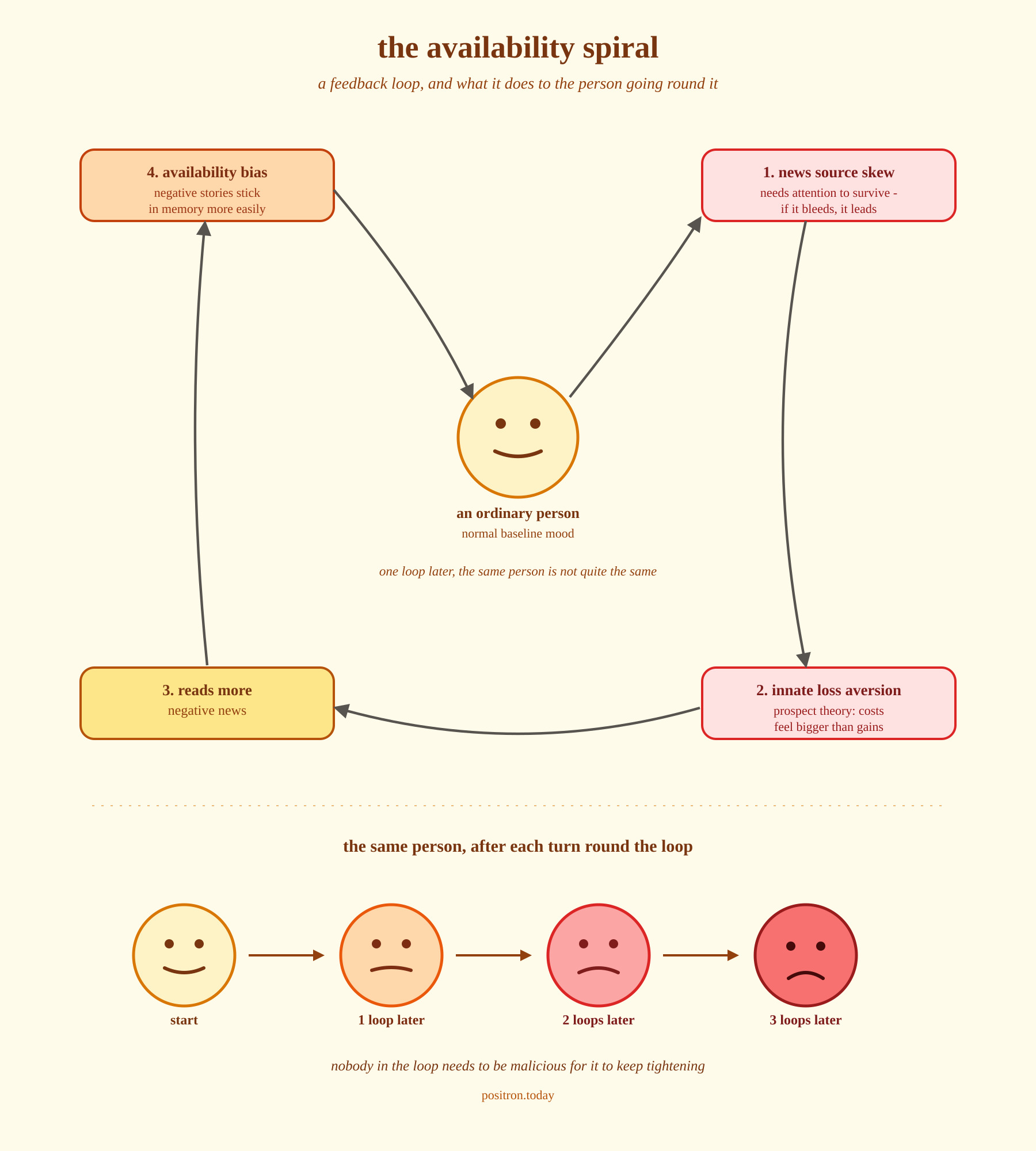
Here's the bit that kept me thinking, days after that podcast episode. The availability bias doesn't work on its own. It sits right next to something I've written about before on Positron: our tendency to feel losses more than gains, and to worry more about small chances of disaster than we should - both part of Kahneman and Tversky's prospect theory. Psychologists have a name for the wider pattern too: negativity bias, our tendency to weigh bad things more heavily than equally good ones. Put the two together and they don't just sit side by side. They feed each other, in a loop that gets a bit tighter every time round. Let me walk you through it, step by step.
- Start with an ordinary person, feeling roughly normal levels of positivity and negativity about the world. Nothing dramatic. Just a normal starting point.
- That person starts reading the news, like we all do. But the news source they're reading needs attention to survive, and attention goes to threat, conflict and loss. If it bleeds, it leads - we've talked about that here before. So the stories reaching this person are already tilted negative, before they've even read a word.
- At the same time, this person is carrying an innate wiring problem, thanks to prospect theory: losses simply feel bigger than equal gains, and small chances of disaster feel bigger than they really are. So even a perfectly balanced mix of news wouldn't feel balanced to them. The negative stories hit harder going in.
- Now the availability bias joins in. Because negative stories are more vivid and more emotional, they're also easier to remember than the quieter positive ones. So they become more available in this person's memory than they should be, given how often they actually happen.
- And here's the turn: a person whose memory now holds more negative material is, in a small but real way, more negative than the person we started with. So the next time they go looking for news - or just think about how things are going - that slightly-more-negative starting point shapes what they look for and what they notice. They read a bit more negative news. Which becomes a bit more available in memory. Which shifts their mood a bit further. Round and round it goes, a little tighter each time - a real downward spiral.
And nobody in it, not the reader, not the editor, not the algorithm, needs to be doing anything you'd call malicious for it to keep turning.
Ask someone how their country, their city, even their own street is doing, and watch how fast the fire comes up, and how rarely the swimming pool does. Not because they're pessimists by nature. Because they've been going round this loop, quietly, for years.
Why this is exactly Positron's job
Once you see the loop this way, it stops feeling like a personality trait and starts feeling like a mechanism. And mechanisms can be interrupted.
That's really the whole idea behind Positron. If the problem were simply that bad things happen more than good things, there wouldn't be much to build. But that's not the problem. Good things happen all the time - swimming pools open, treatments work, problems get quietly solved. They just don't win the fight for your memory, because nothing about them is built to be vivid or alarming. Positron's job is to go looking for that material on purpose, and put it in front of you often enough that it gets a real chance to become available too.
I don't think Kahneman or Tversky ever set out to explain why someone would build a small, stubbornly positive news project in Antwerp. But every time I go back to their work, I find another reason why it needs to exist. Understanding the availability bias won't stop fires from being newsworthy. It just means the swimming pool deserves a place in your memory too.
Cheers / Rik
De herinnering die het nieuws opvrat
Een paar weken geleden luisterde ik half naar een podcast terwijl ik de afwas deed, en de host noemde een naam waar ik al een tijdje niet aan had gedacht: Amos Tversky. Ik liet bijna een bord vallen. Ik ben al jaren gefascineerd door Kahneman en Tversky - ik heb hier eerder op Positron al over hun prospecttheorie en verliesaversie geschreven. Deze podcast ging eigenlijk over Paul Bloom's boek "Psych: The Story of the Human Mind", dat de geschiedenis van de psychologie vertelt, en Blooms samenvatting van de beschikbaarheidsbias bracht iets terug in mijn gedachten dat ik eerder niet echt had verbonden. Dus hier gaan we, weer een verhaal over Kahneman en Tversky. En ik beloof dat dit ook belangrijk is voor Positron.
De bias zelf: wat gemakkelijk te onthouden is, voelt waar aan
In 1973 publiceerden Tversky en Kahneman een paper genaamd "Availability: A heuristic for judging frequency and probability". Het idee is simpel, zodra je het hoort: wanneer we proberen te beoordelen hoe gebruikelijk of waarschijnlijk iets is, rekenen we niet echt. We kijken gewoon hoe gemakkelijk voorbeelden in ons hoofd komen. Als voorbeelden snel opkomen, nemen we aan dat het ding gebruikelijk, belangrijk of gevaarlijk is. Als er niets in ons opkomt, nemen we aan dat het zeldzaam is.
De meeste tijd is dat een prima shortcut. Maar het faalt op een duidelijke manier: recente, dramatische, emotionele gebeurtenissen zijn veel gemakkelijker te onthouden dan langzame, stille - ongeacht hoe vaak elk van beide daadwerkelijk gebeurt.
Laat me je een eenvoudig voorbeeld geven, dichtbij huis. Stel dat er onlangs een bosbrand is uitgebroken in mijn buurt hier in Antwerpen. Ik zal dat herinneren. Ik zal het ter sprake brengen tijdens het diner, ik zal het aan vrienden noemen, het zal maandenlang mijn gedachten over mijn straat beïnvloeden. Stel nu dat, rond dezelfde tijd, er een nieuw zwembad in de buurt is geopend, dat ook als waterreservoir voor de brandweer fungeert. Echt nuttig, echt goed nieuws. Ik zal het waarschijnlijk helemaal niet onthouden. Niet omdat het minder belangrijk is. Gewoon omdat het minder beschikbaar is in mijn geheugen - minder dramatisch, minder plakkerig. Het vuur wint elke keer, en dat doet meer om te bepalen hoe ik mijn eigen straat zie dan ik zou willen toegeven.
Waar het gevaarlijk wordt: een lus, geen eenmalige gebeurtenis
Hier is het stuk dat me aan het denken hield, dagen na die podcastaflevering. De beschikbaarheidsbias werkt niet op zichzelf. Het zit naast iets waar ik eerder op Positron over heb geschreven: onze neiging om verliezen zwaarder te wegen dan winsten, en om ons meer zorgen te maken over kleine kansen op rampen dan we zouden moeten - beide onderdeel van Kahneman en Tversky's prospecttheorie. Psychologen hebben ook een naam voor het bredere patroon: negativiteitsbias, onze neiging om slechte dingen zwaarder te wegen dan even goede. Zet de twee samen en ze zitten niet alleen naast elkaar. Ze voeden elkaar, in een lus die elke keer een beetje strakker wordt. Laat me je er stap voor stap doorheen leiden.
- Begin met een gewone persoon, die ongeveer normale niveaus van positiviteit en negativiteit over de wereld voelt. Niets dramatisch. Gewoon een normaal startpunt.
- Die persoon begint het nieuws te lezen, zoals we allemaal doen. Maar de nieuwsbron die ze lezen heeft aandacht nodig om te overleven, en aandacht gaat naar bedreiging, conflict en verlies. Als het bloedt, leidt het - daar hebben we het hier eerder over gehad. Dus de verhalen die deze persoon bereiken zijn al negatief gekant, voordat ze ook maar een woord hebben gelezen.
- Tegelijkertijd heeft deze persoon een aangeboren bedradingprobleem, dankzij de prospecttheorie: verliezen voelen gewoon groter dan gelijke winsten, en kleine kansen op rampen voelen groter dan ze werkelijk zijn. Zelfs een perfect gebalanceerde mix van nieuws zou voor hen niet gebalanceerd aanvoelen. De negatieve verhalen komen harder binnen.
- Nu komt de beschikbaarheidsbias in het spel. Omdat negatieve verhalen levendiger en emotioneler zijn, zijn ze ook gemakkelijker te onthouden dan de rustigere positieve. Dus ze worden meer beschikbaar in het geheugen van deze persoon dan ze zouden moeten zijn, gezien hoe vaak ze daadwerkelijk gebeuren.
- En hier is de wending: een persoon wiens geheugen nu meer negatief materiaal bevat, is, op een kleine maar reële manier, negatiever dan de persoon met wie we begonnen. Dus de volgende keer dat ze op zoek gaan naar nieuws - of gewoon nadenken over hoe het gaat - vormt dat iets negatievere startpunt wat ze zoeken en wat ze opmerken. Ze lezen iets meer negatief nieuws. Wat iets meer beschikbaar wordt in het geheugen. Wat hun stemming een beetje verder verschuift. Rond en rond gaat het, elke keer iets strakker - een echte neerwaartse spiraal.
En niemand daarin, niet de lezer, niet de redacteur, niet het algoritme, hoeft iets te doen wat je kwaadaardig zou noemen om het draaiende te houden.
Vraag iemand hoe het met hun land, hun stad, zelfs hun eigen straat gaat, en kijk hoe snel het vuur naar boven komt, en hoe zelden het zwembad dat doet. Niet omdat ze van nature pessimistisch zijn. Omdat ze al jaren stilletjes rond deze lus gaan.
Waarom dit precies Positron's taak is
Zodra je de lus op deze manier ziet, voelt het niet meer als een persoonlijkheidskenmerk, maar als een mechanisme. En mechanismen kunnen worden onderbroken.
Dat is eigenlijk het hele idee achter Positron. Als het probleem simpelweg was dat slechte dingen vaker gebeuren dan goede dingen, zou er niet veel te bouwen zijn. Maar dat is niet het probleem. Goede dingen gebeuren de hele tijd - zwembaden openen, behandelingen werken, problemen worden stilletjes opgelost. Ze winnen gewoon de strijd om je geheugen niet, omdat niets aan hen is gebouwd om levendig of alarmerend te zijn. Positron's taak is om opzettelijk naar dat materiaal te zoeken en het vaak genoeg voor je te plaatsen zodat het ook een echte kans krijgt om beschikbaar te worden.
Ik denk niet dat Kahneman of Tversky ooit de bedoeling hadden om uit te leggen waarom iemand een klein, hardnekkig positief nieuwsproject in Antwerpen zou opzetten. Maar elke keer als ik terugga naar hun werk, vind ik een andere reden waarom het moet bestaan. Het begrijpen van de beschikbaarheidsbias zal niet voorkomen dat branden nieuwswaardig zijn. Het betekent gewoon dat het zwembad ook een plek in je geheugen verdient.
Proost / Rik
La mémoire qui a mangé les nouvelles
Il y a quelques semaines, j'écoutais à moitié un podcast en faisant la vaisselle, et l'animateur a mentionné un nom auquel je n'avais pas pensé depuis un moment : Amos Tversky. J'ai failli laisser tomber une assiette. Je suis fasciné par Kahneman et Tversky depuis des années - j'ai déjà écrit sur leur théorie des perspectives et l'aversion à la perte dans un article précédent ici sur Positron. Ce podcast parlait en fait du livre de Paul Bloom "Psych: The Story of the Human Mind", qui raconte l'histoire de la psychologie, et le résumé de Bloom sur le biais de disponibilité a ravivé quelque chose dans mon esprit que je n'avais pas vraiment connecté auparavant. Alors voilà, une autre histoire de Kahneman et Tversky. Et je promets que celle-ci compte aussi pour Positron.
Le biais lui-même : ce qui est facile à retenir semble vrai
En 1973, Tversky et Kahneman ont publié un article intitulé "Availability: A heuristic for judging frequency and probability". L'idée est simple, une fois que vous l'entendez : lorsque nous essayons de juger à quel point quelque chose est commun ou probable, nous ne calculons pas vraiment. Nous vérifions simplement à quelle vitesse des exemples nous viennent à l'esprit. Si des exemples apparaissent rapidement, nous supposons que la chose est commune, ou importante, ou dangereuse. Si rien ne nous vient à l'esprit, nous supposons que c'est rare.
La plupart du temps, c'est un bon raccourci. Mais cela se dégrade d'une manière claire : les événements récents, dramatiques et émotionnels sont beaucoup plus faciles à retenir que les événements lents et calmes - peu importe à quelle fréquence l'un ou l'autre se produit réellement.
Laissez-moi vous donner un exemple simple, proche de chez moi. Disons qu'un incendie de forêt a récemment éclaté près de mon quartier ici à Anvers. Je vais m'en souvenir. J'en parlerai au dîner, je le mentionnerai à des amis, cela façonnera ma perception de ma rue pendant des mois. Maintenant, disons qu'à peu près au même moment, une nouvelle piscine a ouvert à proximité, qui sert également de réserve d'eau pour les pompiers. Vraiment utile, vraiment bonne nouvelle. Je ne vais probablement pas m'en souvenir du tout. Pas parce que cela a moins d'importance. Juste parce que c'est moins disponible dans ma mémoire - moins dramatique, moins marquant. L'incendie l'emporte à chaque fois, et cela façonne plus ma perception de ma propre rue que je ne voudrais l'admettre.
Là où cela devient dangereux : une boucle, pas un événement isolé
Voici ce qui m'a fait réfléchir, des jours après cet épisode de podcast. Le biais de disponibilité ne fonctionne pas tout seul. Il se trouve juste à côté de quelque chose dont j'ai déjà parlé sur Positron : notre tendance à ressentir les pertes plus que les gains, et à nous inquiéter davantage des petites chances de catastrophe que nous ne devrions - les deux faisant partie de la théorie des perspectives de Kahneman et Tversky. Les psychologues ont aussi un nom pour le schéma plus large : biais de négativité, notre tendance à peser les mauvaises choses plus lourdement que les bonnes. Mettez les deux ensemble et ils ne se contentent pas de coexister. Ils se nourrissent mutuellement, dans une boucle qui devient un peu plus serrée à chaque tour. Laissez-moi vous expliquer cela, étape par étape.
- Commencez avec une personne ordinaire, ressentant des niveaux de positivité et de négativité à peu près normaux par rapport au monde. Rien de dramatique. Juste un point de départ normal.
- Cette personne commence à lire les nouvelles, comme nous le faisons tous. Mais la source d'information qu'elle lit a besoin d'attention pour survivre, et l'attention va à la menace, au conflit et à la perte. Si ça saigne, ça mène - nous en avons déjà parlé ici. Donc, les histoires qui atteignent cette personne sont déjà biaisées négativement, avant même qu'elle ait lu un mot.
- En même temps, cette personne porte un problème de câblage inné, grâce à la théorie des perspectives : les pertes semblent simplement plus grandes que les gains équivalents, et les petites chances de catastrophe semblent plus grandes qu'elles ne le sont réellement. Donc, même un mélange parfaitement équilibré de nouvelles ne semblerait pas équilibré pour elle. Les histoires négatives frappent plus fort à l'entrée.
- Maintenant, le biais de disponibilité entre en jeu. Parce que les histoires négatives sont plus vives et plus émotionnelles, elles sont aussi plus faciles à retenir que les histoires positives plus calmes. Elles deviennent donc plus disponibles dans la mémoire de cette personne qu'elles ne devraient l'être, étant donné à quelle fréquence elles se produisent réellement.
- Et voici le tournant : une personne dont la mémoire contient maintenant plus de matériel négatif est, d'une petite mais réelle manière, plus négative que la personne avec laquelle nous avons commencé. Donc, la prochaine fois qu'elle cherche des nouvelles - ou simplement pense à comment les choses se passent - ce point de départ légèrement plus négatif façonne ce qu'elle recherche et ce qu'elle remarque. Elle lit un peu plus de nouvelles négatives. Ce qui devient un peu plus disponible dans sa mémoire. Ce qui déplace son humeur un peu plus loin. Ça tourne en rond, un peu plus serré à chaque fois - une véritable spirale descendante.
Et personne dans cette boucle, ni le lecteur, ni l'éditeur, ni l'algorithme, n'a besoin de faire quoi que ce soit que vous pourriez qualifier de malveillant pour que cela continue de tourner.
Demandez à quelqu'un comment son pays, sa ville, même sa propre rue se porte, et regardez à quelle vitesse l'incendie apparaît, et à quelle rareté la piscine se manifeste. Pas parce qu'ils sont pessimistes par nature. Parce qu'ils ont tourné dans cette boucle, tranquillement, pendant des années.
Pourquoi c'est exactement le travail de Positron
Une fois que vous voyez la boucle de cette manière, elle cesse de sembler être un trait de personnalité et commence à ressembler à un mécanisme. Et les mécanismes peuvent être interrompus.
C'est vraiment toute l'idée derrière Positron. Si le problème était simplement que les mauvaises choses se produisent plus que les bonnes, il n'y aurait pas grand-chose à construire. Mais ce n'est pas le problème. De bonnes choses se produisent tout le temps - des piscines ouvrent, des traitements fonctionnent, des problèmes se résolvent discrètement. Elles ne gagnent tout simplement pas le combat pour votre mémoire, parce que rien à leur sujet n'est conçu pour être vivant ou alarmant. Le travail de Positron est de chercher ce matériel intentionnellement, et de le mettre devant vous assez souvent pour qu'il ait une vraie chance de devenir disponible aussi.
Je ne pense pas que Kahneman ou Tversky aient jamais cherché à expliquer pourquoi quelqu'un construirait un petit projet d'actualités obstinément positif à Anvers. Mais chaque fois que je reviens à leur travail, je trouve une autre raison pour laquelle il doit exister. Comprendre le biais de disponibilité ne fera pas en sorte que les incendies ne soient plus dignes d'intérêt. Cela signifie simplement que la piscine mérite aussi une place dans votre mémoire.
Santé / Rik