We measured how rare good news actually is. It's worse than you think...
I want to show you a single number, and then spend a few paragraphs on why it kept me up a little.
Sixty-two percent.
That's the share of "source-days" in our data on which a news outlet published exactly zero clearly-positive articles. Not "a bit negative". Not "mostly grim with a silver lining". Zero. Nothing that our scoring model looked at and said, yeah, that's genuinely good news.
Let me be precise about what that does and doesn't mean, because it's easy to over-read. It does not mean that on 62 percent of days there was no good news anywhere - across all our sources combined, almost every single day had at least some. What it means is narrower, and in a way more telling: take any one outlet on any one day, and about six times out of ten, that outlet ran nothing positive at all. The good news exists, but it's scattered so thinly that no single publication reliably carries it.
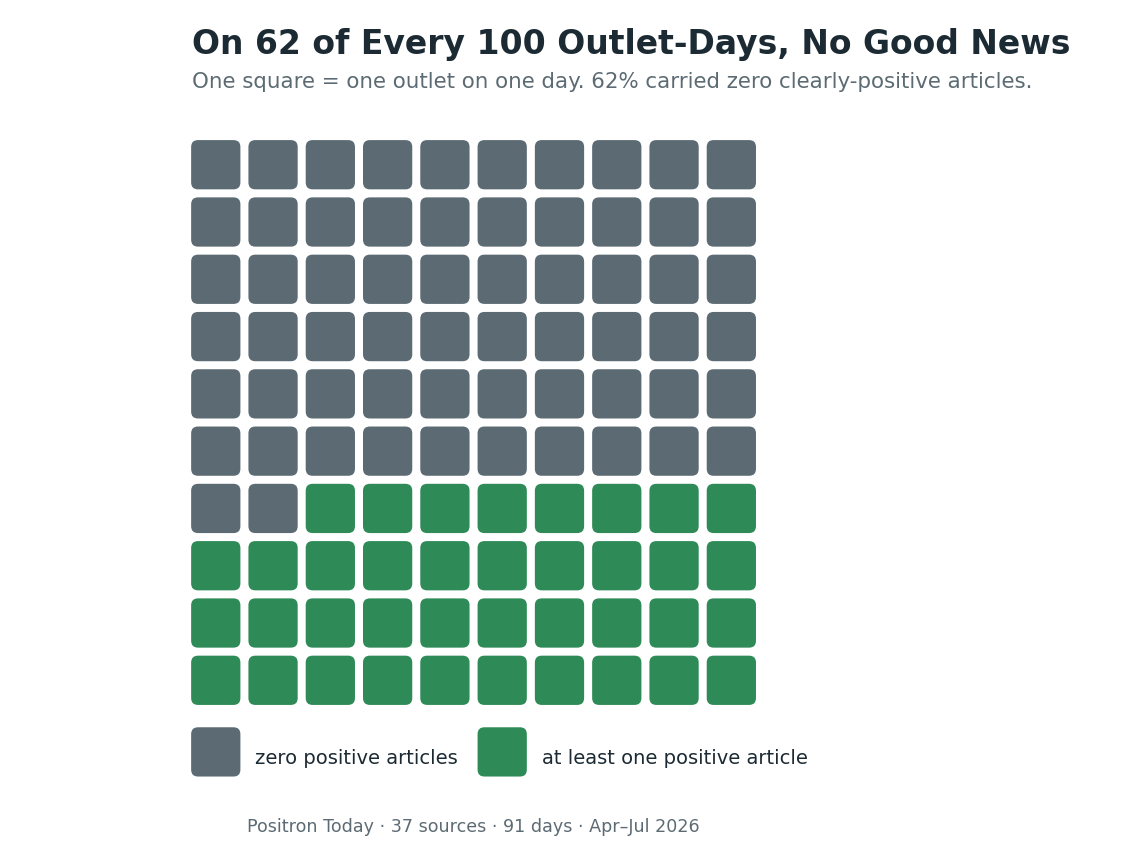
Let me back up and explain where that comes from, because I think the method matters. For the last few months, every article coming through Positron's feeds gets read by an AI model and scored from 1 to 10 on positivity. Seven and up is "clearly positive". I took 91 days of that - 37 news sources, more than 77,000 articles, from all over Europe and North America - and just started counting.
The headline stats look like this. The average positivity across everything is about 7 percent. Sounds low already, right? But the average is lying to you a little, because it's being propped up by a handful of dedicated good-news sites. The number that actually tells the truth is the median, and the median is zero. Zero percent. If you line up every outlet-and-day combination and walk to the middle of the queue, the one you land on contains no clearly-positive articles at all.
Now, I want to be really careful and fair here, because it would be easy to twist this into doom, and doom is exactly what we're trying to push back against. So two honest caveats.
First: a low positivity score does not mean the news is all negative. Our model sorts things into positive, neutral, and negative. A newspaper sitting at 1 percent positive is not 99 percent catastrophe - most of the rest is neutral. Factual. A council meeting, a match report, a quarterly result. So the picture isn't "the world is on fire", it's more like "the world is beige, with occasional flashes of red, and very rarely a bit of green".
Second: these scores come from an AI. It's consistent, but it has its own idea of what "positive" means, and it's not infallible. I'm not claiming three-decimal precision here. But the pattern is so strong, and so consistent across dozens of very different outlets, that I'm confident the shape of it is real.
And the shape is this: good news is not rare like a nice day is rare. It's rare like a four-leaf clover is rare. On most days, in most outlets, there simply isn't any.
Here's the bit that got me, though. I also looked at the sites whose entire reason for existing is uplifting news - the Positive News, the Good News Network. Surely they're at 90-odd percent? Nope. Even they clear the "clearly positive" bar only about half the time. Half! And that's not a criticism of them - they do lovely work. It's a measure of how demanding reality is. When a team of people whose whole job is finding good news still comes up with a coin-flip, you realise how much of what happens in the world genuinely resists a positive framing.
So what do I take from all this? Honestly, not despair - the opposite. This is more or less the whole thesis behind Positron in one spreadsheet. If good news is a one-or-two-percent trickle scattered across dozens of feeds, then no single person is ever going to stumble across enough of it to feel any different about the world. It's too thin, too spread out. You'd have to read everything to find the good bits, and nobody has time to read everything.
That's the job we've quietly given ourselves. Read everything, so you don't have to, and hand you back the two percent. Concentrate the green.
Turns out that trickle is even smaller than I assumed when we started. Which, weirdly, makes me more convinced the work is worth doing, not less.
There's more buried in this data that surprised me, and I'll share the best bits as I keep digging. But this was the finding I most wanted to start with.
Cheers
Rik
We hebben gemeten hoe zeldzaam goed nieuws eigenlijk is. Het is erger dan je denkt...
Ik wil je een enkel getal laten zien, en dan een paar alinea's besteden aan waarom het me een beetje wakker hield.
Tweeënzestig procent.
Dat is het aandeel van "bron-dagen" in onze gegevens waarop een nieuwsorganisatie precies nul duidelijk positieve artikelen publiceerde. Niet "een beetje negatief". Niet "voornamelijk somber met een zilveren randje". Nul. Niets waar ons scoringsmodel naar keek en zei: ja, dat is oprecht goed nieuws.
Laat me precies zijn over wat dat wel en niet betekent, want het is gemakkelijk om dit verkeerd te interpreteren. Het betekent niet dat er op 62 procent van de dagen nergens goed nieuws was - over al onze bronnen gecombineerd had bijna elke enkele dag ten minste wat goed nieuws. Wat het betekent is nauwer, en op een manier meer onthullend: neem een enkele outlet op een enkele dag, en ongeveer zes keer op de tien publiceerde die outlet helemaal niets positiefs. Het goede nieuws bestaat, maar het is zo dun verspreid dat geen enkele publicatie het betrouwbaar draagt.
Laat me terugkomen en uitleggen waar dat vandaan komt, want ik denk dat de methode belangrijk is. De afgelopen maanden werd elk artikel dat via de feeds van Positron binnenkwam gelezen door een AI-model en gescoord van 1 tot 10 op positiviteit. Zeven en hoger is "duidelijk positief". Ik nam 91 dagen daarvan - 37 nieuwsbronnen, meer dan 77.000 artikelen, uit heel Europa en Noord-Amerika - en begon gewoon te tellen.
De hoofdcijfers zien er als volgt uit. De gemiddelde positiviteit over alles is ongeveer 7 procent. Klinkt al laag, toch? Maar het gemiddelde liegt een beetje tegen je, omdat het wordt opgevijzeld door een handvol toegewijde goed-nieuws sites. Het getal dat de waarheid vertelt is de mediaan, en de mediaan is nul. Nul procent. Als je elke combinatie van outlet en dag op een rijtje zet en naar het midden van de rij loopt, bevat degene waar je op landt helemaal geen duidelijk positieve artikelen.
Nu wil ik hier echt voorzichtig en eerlijk zijn, want het zou gemakkelijk zijn om dit om te draaien in doem, en doem is precies waar we tegen proberen te vechten. Dus twee eerlijke kanttekeningen.
Eerst: een lage positiviteitsscore betekent niet dat het nieuws allemaal negatief is. Ons model sorteert dingen in positief, neutraal en negatief. Een krant met 1 procent positief is niet 99 procent catastrofe - het grootste deel van de rest is neutraal. Feitelijk. Een raadsvergadering, een wedstrijdverslag, een kwartaalresultaat. Dus het beeld is niet "de wereld staat in brand", het is meer als "de wereld is beige, met af en toe flitsen van rood, en heel zelden een beetje groen".
Ten tweede: deze scores komen van een AI. Het is consistent, maar het heeft zijn eigen idee van wat "positief" betekent, en het is niet onfeilbaar. Ik beweer hier geen precisie tot op drie decimalen. Maar het patroon is zo sterk, en zo consistent over tientallen zeer verschillende outlets, dat ik er zeker van ben dat de vorm ervan echt is.
En de vorm is dit: goed nieuws is niet zeldzaam zoals een mooie dag zeldzaam is. Het is zeldzaam zoals een klavertje vier zeldzaam is. Op de meeste dagen, in de meeste outlets, is er simpelweg geen goed nieuws.
Hier is het stuk dat me raakte. Ik keek ook naar de sites waarvan de hele reden van bestaan opbeurend nieuws is - de Positive News, het Good News Network. Zeker zijn ze op 90 procent of zo? Nee. Zelfs zij halen de "duidelijk positieve" drempel maar ongeveer de helft van de tijd. De helft! En dat is geen kritiek op hen - ze doen prachtig werk. Het is een maatstaf voor hoe veeleisend de realiteit is. Wanneer een team van mensen wiens hele taak het is om goed nieuws te vinden nog steeds met een muntworp komt, realiseer je je hoeveel van wat er in de wereld gebeurt echt weerstand biedt tegen een positieve framing.
Dus wat neem ik hieruit mee? Eerlijk gezegd, geen wanhoop - het tegenovergestelde. Dit is min of meer de hele thesis achter Positron in één spreadsheet. Als goed nieuws een stroom van één of twee procent is die verspreid is over tientallen feeds, dan zal geen enkele persoon ooit genoeg tegenkomen om zich anders te voelen over de wereld. Het is te dun, te verspreid. Je zou alles moeten lezen om de goede stukjes te vinden, en niemand heeft tijd om alles te lezen.
Dat is de taak die we ons stilletjes hebben opgelegd. Lees alles, zodat jij dat niet hoeft te doen, en geef je de twee procent terug. Concentreer het groen.
Het blijkt dat die stroom zelfs kleiner is dan ik aannam toen we begonnen. Wat, vreemd genoeg, me meer overtuigd maakt dat het werk de moeite waard is, niet minder.
Er is meer verborgen in deze gegevens dat me verraste, en ik zal de beste stukjes delen terwijl ik verder graaf. Maar dit was de bevinding waarmee ik het meest wilde beginnen.
Proost
Rik
Nous avons mesuré à quel point les bonnes nouvelles sont en réalité rares. C'est pire que ce que vous pensez...
Je veux vous montrer un seul chiffre, puis passer quelques paragraphes sur la raison pour laquelle il m'a tenu éveillé un peu.
Soixante-deux pour cent.
C'est la part des "jours-sources" dans nos données sur lesquels un média a publié exactement zéro article clairement positif. Pas "un peu négatif". Pas "principalement sombre avec un rayon de soleil". Zéro. Rien que notre modèle de notation a regardé et a dit, ouais, c'est vraiment une bonne nouvelle.
Laissez-moi être précis sur ce que cela signifie et ce que cela ne signifie pas, car il est facile de mal interpréter. Cela ne signifie pas que pendant 62 pour cent des jours, il n'y avait pas de bonnes nouvelles nulle part - à travers toutes nos sources combinées, presque chaque jour avait au moins quelques bonnes nouvelles. Ce que cela signifie est plus étroit, et d'une certaine manière plus révélateur : prenez n'importe quel média un jour donné, et environ six fois sur dix, ce média n'a rien publié de positif du tout. Les bonnes nouvelles existent, mais elles sont dispersées si finement qu'aucune publication unique ne les diffuse de manière fiable.
Laissez-moi reculer et expliquer d'où cela vient, car je pense que la méthode est importante. Au cours des derniers mois, chaque article provenant des flux de Positron est lu par un modèle d'IA et noté de 1 à 10 sur la positivité. Sept et plus est "clairement positif". J'ai pris 91 jours de cela - 37 sources d'actualités, plus de 77 000 articles, provenant de toute l'Europe et de l'Amérique du Nord - et j'ai simplement commencé à compter.
Les statistiques principales ressemblent à ceci. La positivité moyenne à travers tout est d'environ 7 pour cent. Ça semble déjà bas, non ? Mais la moyenne vous ment un peu, car elle est soutenue par une poignée de sites dédiés aux bonnes nouvelles. Le chiffre qui dit réellement la vérité est la médiane, et la médiane est zéro. Zéro pour cent. Si vous alignez chaque combinaison média-jour et marchez vers le milieu de la file, celui sur lequel vous tombez ne contient aucun article clairement positif.
Maintenant, je veux être vraiment prudent et juste ici, car il serait facile de tordre cela en un discours de désespoir, et le désespoir est exactement ce contre quoi nous essayons de lutter. Donc, deux mises en garde honnêtes.
Premièrement : un faible score de positivité ne signifie pas que les nouvelles sont toutes négatives. Notre modèle classe les choses en positif, neutre et négatif. Un journal ayant un score de 1 pour cent positif n'est pas 99 pour cent de catastrophe - la plupart du reste est neutre. Factuel. Une réunion du conseil, un rapport de match, un résultat trimestriel. Donc, l'image n'est pas "le monde est en feu", c'est plutôt "le monde est beige, avec des éclairs occasionnels de rouge, et très rarement un peu de vert".
Deuxièmement : ces scores proviennent d'une IA. C'est cohérent, mais cela a sa propre idée de ce que signifie "positif", et ce n'est pas infaillible. Je ne prétends pas à une précision à trois décimales ici. Mais le schéma est si fort, et si cohérent à travers des dizaines de médias très différents, que je suis convaincu que sa forme est réelle.
Et la forme est la suivante : les bonnes nouvelles ne sont pas rares comme un beau jour est rare. C'est rare comme un trèfle à quatre feuilles est rare. La plupart des jours, dans la plupart des médias, il n'y en a tout simplement pas.
Voici ce qui m'a frappé, cependant. J'ai également regardé les sites dont la raison d'être entière est de diffuser des nouvelles encourageantes - Positive News, Good News Network. Ils sont sûrement à 90 pour cent, non ? Non. Même eux franchissent la barre des "clairement positifs" seulement environ la moitié du temps. La moitié ! Et ce n'est pas une critique à leur égard - ils font un travail formidable. C'est une mesure de la dureté de la réalité. Quand une équipe de personnes dont tout le travail consiste à trouver de bonnes nouvelles en arrive encore à un tirage au sort, vous réalisez à quel point une grande partie de ce qui se passe dans le monde résiste réellement à un cadre positif.
Alors, que tirer de tout cela ? Honnêtement, pas de désespoir - le contraire. C'est plus ou moins toute la thèse derrière Positron dans un tableau. Si les bonnes nouvelles sont un filet d'un ou deux pour cent éparpillé à travers des dizaines de flux, alors aucune personne seule ne va jamais tomber sur suffisamment de bonnes nouvelles pour se sentir différente à propos du monde. C'est trop mince, trop étalé. Vous devriez tout lire pour trouver les bonnes parties, et personne n'a le temps de tout lire.
C'est le travail que nous nous sommes discrètement donné. Lire tout, pour que vous n'ayez pas à le faire, et vous rendre les deux pour cent. Concentrer le vert.
Il s'avère que ce filet est encore plus petit que je ne l'avais supposé au début. Ce qui, étrangement, me convainc encore plus que le travail en vaut la peine, pas moins.
Il y a plus de choses enfouies dans ces données qui m'ont surpris, et je partagerai les meilleurs éléments au fur et à mesure que je continue à creuser. Mais c'était la découverte que je voulais le plus partager en premier.
Santé
Rik