Why the weekend news feels heavier (it's not just you)
Here's a small one, but it's the kind of finding I love, because it matches something you've probably felt without ever being able to prove.
You know that feeling on a Sunday, when you pick up the phone or the paper and the news just sits on you a bit more heavily? Grinding conflict, long grim think-pieces, the general sense that the world has slowed down and gone dark. And then Monday morning rolls around and there's a bit more life in it - a discovery, an announcement, something that moves forward.
Well. It turns out that's not just your Sunday mood. It's in the data.
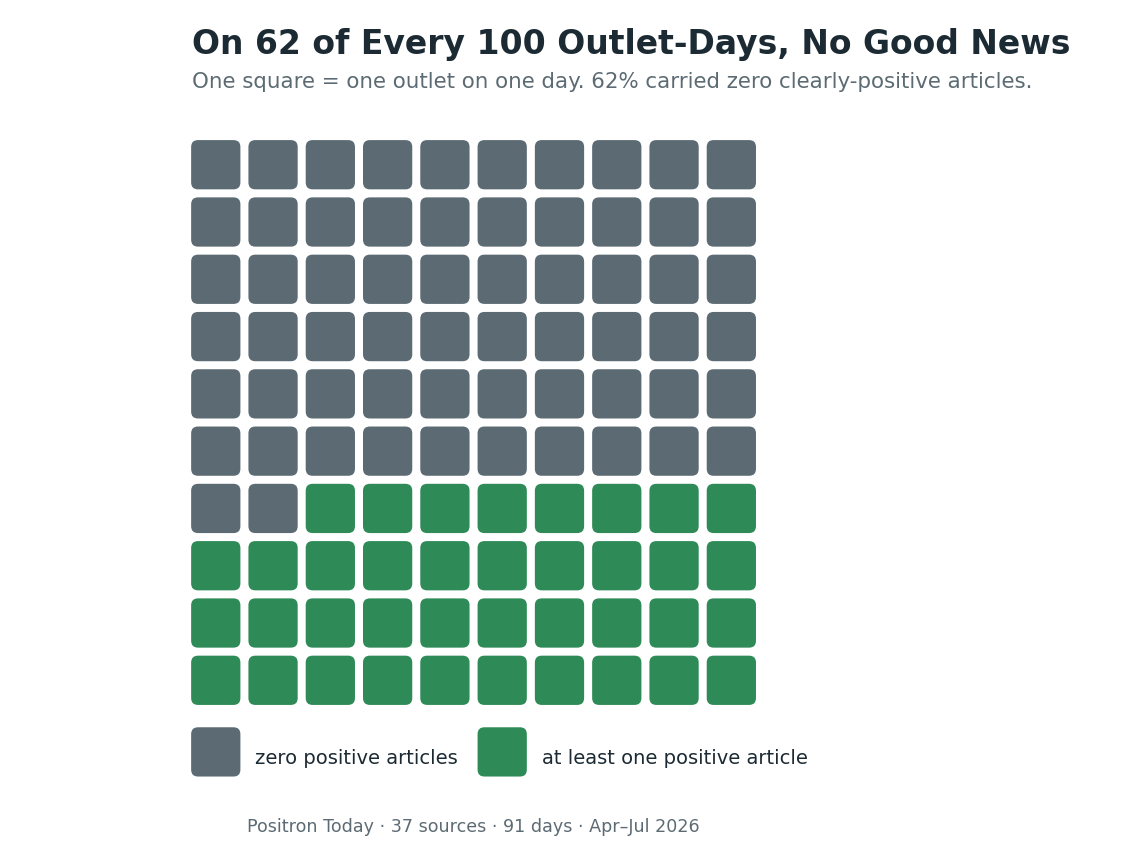
Let me explain what I've been up to. Positron scores every article that comes through our feeds from 1 to 10 on how positive it is, and I've been sitting with 91 days of those scores across 37 news sources. One of the things I checked was the day of the week. Simple question: is the news more positive on some days than others?
And yes. Clearly.
The weekday average comes in at about 7.4 percent clearly-positive articles. The weekend average? 4.8 percent. That gap is big enough that it's very unlikely to be chance - I ran the numbers, and it holds up. Monday is the sunniest day of the week, sitting up around 8 percent. Then it drifts gently down through the week, and then it falls off a small cliff on Saturday and bottoms out on Sunday at under 5 percent.
So the weekend news really is greyer. You weren't imagining it.
Now, why? I can't prove the mechanism from the data alone, but I've got a pretty strong hunch, and it's about how newsrooms actually work. The genuinely positive stuff - the science stories, the research announcements, the "look at this wonderful thing someone built" features - tends to be produced during the working week. Universities and companies and institutions send out their news Monday to Friday, on office hours. That whole machine goes quiet at the weekend.
But the hard news never clocks off. Conflict, disasters, politics - that keeps happening seven days a week, and on a Saturday and Sunday there's simply less of the good stuff being published alongside it to balance the scales. Thinner weekend newsrooms, running on breaking news and long reads, with the cheerful feature pipeline switched off until Monday. The mix curdles.
It's a bit like the difference between a weekday market full of fresh produce and a Sunday corner shop - the corner shop isn't malicious, it's just working with what's left on the shelf.
I find this weirdly comforting, actually. Partly because it's nice to have a lived feeling confirmed by numbers - that never gets old for me. But also because it's a useful little piece of self-knowledge. If you notice the news is dragging your mood down on a Sunday, it might genuinely be worth going a bit easier on yourself, and maybe saving the deeper reading for a Monday when the balance tilts back.
And - not to be too on-the-nose about it - this is exactly the sort of thing a filter like ours is meant to smooth out. If the good news arrives in a lumpy weekly rhythm, bunched up on weekdays and drying up at the weekend, then part of our job is to even that out. To make sure there's still something worth smiling about on your feed on a grey Sunday afternoon, even when the newsrooms have mostly gone home.
Small finding. But a real one. The weekend news is heavier, it's about two-and-a-half percentage points heavier to be precise, and now at least you know it's the calendar and not you.
I've got a few more of these coming - some of them a lot bigger than this. But I liked starting with the one you can feel in your bones.
Cheers
Rik
Waarom het weekendnieuws voelt zwaarder (het is niet alleen jou)
Hier is een klein ding, maar het soort bevinding waar ik van hou, omdat het aansluit bij iets wat je waarschijnlijk hebt gevoeld zonder het ooit te kunnen bewijzen.
Je kent dat gevoel op een zondag, wanneer je je telefoon of krant pakt en het nieuws voelt gewoon wat zwaarder op je liggen? Slepende conflicten, lange grauwe denkstukkken, het algemene gevoel dat de wereld vertraagd is en donkerder is geworden. En dan komt maandagochtend en er zit wat meer leven in – een ontdekking, een aankondiging, iets wat vooruitgaat.
Nou. Het blijkt dat dat niet alleen je zondagsbui is. Het zit in de data.
Laat me uitleggen wat ik aan het doen ben geweest. Positron beoordeelt elk artikel dat door onze feeds komt van 1 tot 10 op hoe positief het is, en ik ben bezig geweest met 91 dagen van die scores over 37 nieuwsbronnen. Een van de dingen die ik controleerde was de dag van de week. Eenvoudige vraag: is het nieuws op bepaalde dagen positiever dan op andere?
En ja. Duidelijk.
Het weekdaggemiddelde ligt op ongeveer 7,4 procent duidelijk-positieve artikelen. Het weekendgemiddelde? 4,8 procent. Die kloof is groot genoeg dat het zeer onwaarschijnlijk is dat dit toeval is – ik heb de getallen doorgerekend, en het gaat op. Maandag is de zonnigste dag van de week, rond de 8 procent. Dan daalt het langzaam af door de week, en dan valt het op zaterdag met een kleine klif, en bereikt het dieptepunt op zondag op onder de 5 procent.
Het weekendnieuws is dus echt grouwer. Je verbeeldde het je niet.
Nu, waarom? Ik kan het mechanisme alleen niet uit de data bewijzen, maar ik heb een behoorlijk sterk vermoeden, en het gaat over hoe redacties eigenlijk werken. Het werkelijk positieve spul – de wetenschapsverhalen, de onderzoeksaankondigingen, de "kijk wat dit wonderbaarlijke ding iemand heeft gebouwd" features – wordt meestal geproduceerd tijdens de werkweek. Universiteiten en bedrijven en instellingen sturen hun nieuws maandag tot vrijdag, op kantooruren. Die hele machine zwijgt in het weekend.
Maar het hard nieuws slaat nooit af. Conflicten, rampen, politiek – dat gebeurt zeven dagen per week, en op zaterdag en zondag is er simpelweg minder van het goede spul dat wordt gepubliceerd ernaast om de balans te houden. Dunnere weekendredacties, werkend met breaking news en lange artikelen, met de vrolijke featurepipeline uitgeschakeld tot maandag. De mix wordt zuur.
Het is een beetje als het verschil tussen een weekdagmarkt vol vers product en een zondagskruideniertje – het kruideniertje is niet kwaadaardig, het werkt gewoon met wat er nog op de plank ligt.
Ik vind dit eigenlijk raar geruststellend. Deels omdat het fijn is om een ervaren gevoel bevestigd te zien door getallen – dat wordt voor mij nooit oud. Maar ook omdat het een nuttig stukje zelfkennis is. Als je merkt dat het nieuws je stemming op een zondag naar beneden trekt, kan het echt de moeite waard zijn om jezelf wat meer ruimte te geven, en misschien de diepere lektuur tot maandag uit te stellen wanneer de balans terugtilt.
En – niet om te voetstoots te zeggen – dit is precies het soort ding waar een filter zoals de onze voor bedoeld is om uit te vlakken. Als het goede nieuws in een hobbelig wekelijks ritme aankomt, opgestapeld op weekdagen en opdroogend in het weekend, dan is een deel van ons werk om dat uit te vlakken. Om zeker te stellen dat er op je feed op een grijze zondagmiddag nog steeds iets is waar je om kunt glimlachen, zelfs wanneer de redacties grotendeels naar huis zijn gegaan.
Klein bevinding. Maar een echte. Het weekendnieuws is zwaarder, het is ongeveer twee en een halve procentpunt zwaarder om precies te zijn, en nu weet je in ieder geval dat het de kalender is en niet jou.
Ik heb er nog een paar komen – sommige ervan veel groter dan deze. Maar ik vond het leuk om te beginnen met degene die je in je botten voelt.
Sterkte
Rik
Pourquoi les informations du week-end paraissent plus lourdes (ce n'est pas juste vous)
Voici une petite découverte, mais c'est le genre de résultat que j'adore, parce qu'elle correspond à quelque chose que vous avez probablement ressenti sans jamais pouvoir le prouver.
Vous connaissez cette sensation le dimanche, quand vous prenez votre téléphone ou le journal et les informations vous pèsent juste un peu plus lourdement ? Des conflits qui s'éternisent, de longs articles sombres et sinistres, la sensation générale que le monde s'est ralenti et s'est assombri. Et puis lundi matin arrive et il y a un peu plus de vie dedans - une découverte, une annonce, quelque chose qui avance.
Eh bien. Il s'avère que ce n'est pas juste votre humeur de dimanche. C'est dans les données.
Laissez-moi vous expliquer ce que j'ai fait. Positron évalue chaque article qui passe par nos flux de 1 à 10 selon son caractère positif, et j'ai analysé 91 jours de ces évaluations provenant de 37 sources d'information. L'une des choses que j'ai vérifiées était le jour de la semaine. Question simple : les informations sont-elles plus positives certains jours que d'autres ?
Et oui. C'est clair.
La moyenne en semaine s'élève à environ 7,4 pour cent d'articles clairement positifs. La moyenne du week-end ? 4,8 pour cent. Cet écart est assez important pour qu'il soit très peu probable que ce soit le hasard - j'ai fait les calculs, et ça tient la route. Le lundi est le jour le plus ensoleillé de la semaine, se situant autour de 8 pour cent. Puis ça diminue doucement au cours de la semaine, et puis ça chute d'une petite falaise le samedi et atteint son minimum le dimanche à moins de 5 pour cent.
Donc les informations du week-end sont vraiment plus grises. Vous ne l'imaginiez pas.
Maintenant, pourquoi ? Je ne peux pas prouver le mécanisme uniquement à partir des données, mais j'ai une très bonne intuition à ce sujet, et ça concerne la façon dont les salles de rédaction fonctionnent réellement. Les choses véritablement positives - les histoires de science, les annonces de recherche, les articles « regardez cette chose magnifique que quelqu'un a créée » - ont tendance à être produites pendant la semaine de travail. Les universités, les entreprises et les institutions envoient leurs communiqués lundi à vendredi, pendant les heures de bureau. Toute cette machine s'arrête le week-end.
Mais les vraies informations ne ferment jamais. Les conflits, les catastrophes, la politique - tout ça continue sept jours par semaine, et samedi et dimanche il y a simplement moins de bonnes nouvelles publiées aux côtés pour rééquilibrer les choses. Des salles de rédaction plus réduites le week-end, fonctionnant sur les dernières nouvelles et les longs articles, avec le tuyau agréable des articles de reportage fermé jusqu'à lundi. Le mélange s'aigrit.
C'est un peu comme la différence entre un marché en semaine plein de produits frais et un petit magasin du coin le dimanche - le petit magasin n'est pas malveillant, il fonctionne juste avec ce qui reste sur les rayons.
Je trouve ça bizarrement réconfortant, en réalité. En partie parce que c'est agréable d'avoir un sentiment vécu confirmé par des chiffres - ça ne vieillit jamais pour moi. Mais aussi parce que c'est une information personnelle utile. Si vous remarquez que les informations vous tirent le moral vers le bas le dimanche, ça vaut probablement le coup de vous ménager un peu, et peut-être de garder la lecture plus approfondie pour lundi quand l'équilibre se rétablit.
Et - pour ne pas être trop explicite à ce sujet - c'est exactement le genre de chose qu'un filtre comme le nôtre est censé lisser. Si les bonnes informations arrivent selon un rythme hebdomadaire inégal, concentrées les jours de semaine et se tarissant le week-end, alors une partie de notre travail est d'équilibrer tout ça. De s'assurer qu'il y ait toujours quelque chose qui vaut le coup de sourire dans votre flux un dimanche après-midi gris, même quand les salles de rédaction sont essentiellement rentrées à la maison.
Petite découverte. Mais une vraie. Les informations du week-end sont plus lourdes, elles sont plus lourdes d'environ deux virgule cinq points de pourcentage pour être précis, et maintenant au moins vous savez que c'est le calendrier et pas vous.
J'en ai quelques autres qui arrivent - certaines bien plus importantes que celle-ci. Mais j'ai aimé commencer par celle que vous pouvez sentir dans vos os.
Santé
Rik