Negativity isn't a bug, it's on the syllabus
A long time ago, before graphs and databases and all the rest of it, I did a bit of technology journalism. Nothing grand - I was a freelancer at the end of the nineties, writing for Datatestlab and Datanews here in Belgium. I never went to journalism school, never sat through a single lecture on the theory of the trade. I just wrote about tech and got paid by the piece. So when people ask me why the news is so relentlessly negative - and they do ask, usually with a sort of tired resignation - I don't answer as some credentialed insider. I answer as someone who stood near the edge of it for a while, and who only much later found out there was a whole theory underneath the thing I'd been doing on instinct.
On this site I've written before about the two usual suspects. There's the brain: we're wired so that bad is stronger than good, losses hurt more than equivalent gains, and a single nasty comment outlives a week of praise. And there's the machine: the algorithms that learned to sell us anger, weighting an outraged reaction five times heavier than a like.
Both are real. But both, if I'm honest, let the profession itself off the hook a little too easily. Because there's a layer in between the caveman brain and the Facebook algorithm - and that layer is the craft of journalism. And that's the one I want to talk about.
the checklist nobody tells you about
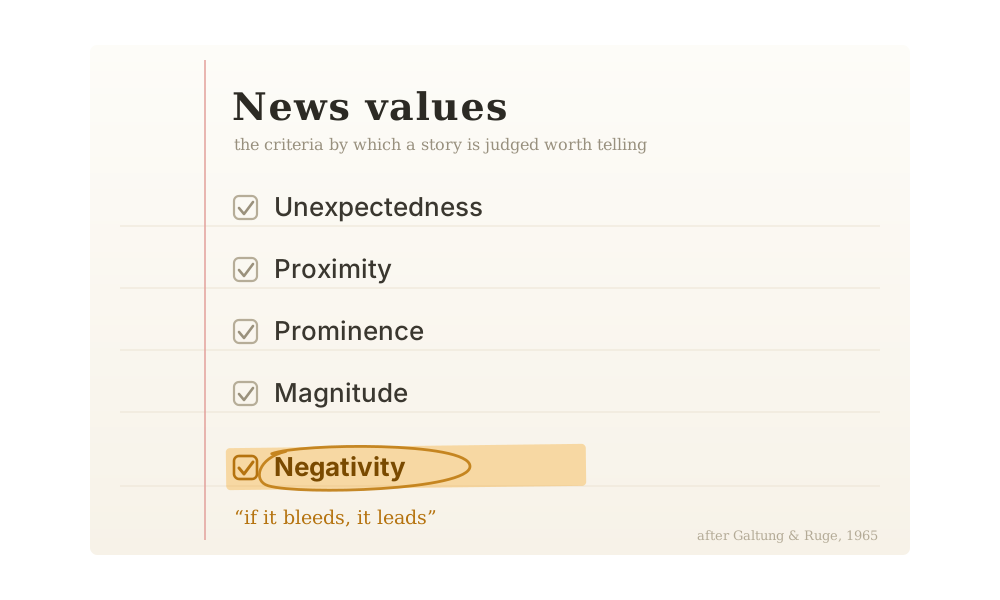
Here's the thing I didn't fully appreciate until years later. Journalists don't decide what's "news" by instinct alone. There's a theory underneath it, and it has a name: news values. Back in 1965, two Norwegian researchers, Johan Galtung and Mari Holmboe Ruge, went through a pile of newspapers and worked out which factors made an event more likely to be reported. They ended up with a list of roughly twelve.
And right there on the list, sitting between "unexpectedness" and "reference to elite nations", is one word: negativity. Bad news, their framework says plainly, is simply more newsworthy than good news. A tragedy, a crash, a scandal, a disaster - all of it scores higher than a wedding or a recovery or a quiet, boring success. Decades later, when Tony Harcup and Deirdre O'Neill updated the list for the modern era, "bad news" survived the rewrite intact. It's still on there.
This is not some obscure academic footnote. These frameworks are in the textbooks. They're on the reading lists of journalism programmes around the world. They are, quite literally, part of what you learn when you learn to be a journalist.
And I want to be careful here, because this is the point that matters most to me: nobody teaches you to be negative. There is no lecturer standing at the front of the room saying "make it grim." That's not how it works, and I don't think it's a conspiracy. What happens is subtler and, honestly, more durable than a conspiracy. Negativity gets formalised. It's written down as a neutral-sounding criterion of quality - a measure of what makes a story worth telling. And once something is on the syllabus, it stops feeling like a choice. It just feels like the job.
"if it bleeds, it leads"
The newsroom has always known this in its own blunter language. "If it bleeds, it leads" - the phrase turns up in print as far back as a 1989 New York magazine piece by the journalist Eric Pooley, complaining that the thoughtful report always gets buried because the sensational story has to open the broadcast. That's the same idea as Galtung and Ruge's "negativity", just with the academic varnish stripped off. The theory and the trade lore agree completely. Bad news goes first.
So between the two of them - the textbook and the newsroom slang - a young journalist absorbs the rule from both directions at once. From above, as theory. From beside them, as culture. No wonder it sticks.
the twist I love
And now the part I find genuinely delicious. Johan Galtung, the man whose name is attached to that list, spent later years saying the media had misread him. He felt the profession had taken his work and become far too negative, too sensational, too adversarial. He described something that was happening in the news - and watched it get treated as an instruction for how news should be.
That, to me, is the whole thing in one sentence. Negativity in the news isn't destiny. It isn't your amygdala and it isn't only Mark Zuckerberg. It's a choice that got written down so long ago, and repeated so faithfully, that we forgot it was ever a choice at all.
But anything that was written into the syllabus can be written back out of it. That's not naive optimism - it's just the logical consequence of realising that this was never a law of physics. It was a convention. And conventions can change.
Which is, when you get right down to it, the entire reason positron exists. Not to pretend the bad stuff isn't there. Just to quietly, stubbornly, put a different item at the top of the list.
Cheers
Rik
Negativiteit is geen bug, het staat op het lesprogramma
Lang geleden, voordat er grafieken en databases waren en al het andere, deed ik een beetje technologiejournalistiek. Niets groots - ik was een freelancer aan het eind van de jaren negentig, schreef voor Datatestlab en Datanews hier in België. Ik ben nooit naar de journalistenopleiding gegaan, heb nooit een enkele lezing over de theorie van het vak bijgewoond. Ik schreef gewoon over technologie en werd per stuk betaald. Dus wanneer mensen me vragen waarom het nieuws zo onverbiddelijk negatief is - en dat vragen ze, meestal met een soort vermoeide berusting - antwoord ik niet als een gecertificeerde insider. Ik antwoord als iemand die een tijdje aan de rand stond en pas veel later ontdekte dat er een hele theorie onder het instinctieve werk zat dat ik deed.
Op deze site heb ik eerder geschreven over de twee gebruikelijke verdachten. Er is de hersenen: we zijn zo geprogrammeerd dat slecht sterker is dan goed, verliezen doen meer pijn dan equivalente winsten, en een enkele nare opmerking overleeft een week van lof. En er is de machine: de algoritmen die hebben geleerd om ons woede te verkopen, die een verontwaardigde reactie vijf keer zwaarder wegen dan een like.
Beide zijn echt. Maar beide, als ik eerlijk ben, laten het beroep zelf iets te gemakkelijk ontsnappen. Want er is een laag tussen de oermenselijke hersenen en het Facebook-algoritme - en die laag is het vak van de journalistiek. En dat is waar ik het over wil hebben.
de checklist waar niemand je over vertelt
Hier is het punt dat ik pas jaren later volledig waardeerde. Journalisten beslissen niet alleen op instinct wat "nieuws" is. Er is een theorie onderliggende, en die heeft een naam: nieuwswaarden. Terug in 1965 gingen twee Noorse onderzoekers, Johan Galtung en Mari Holmboe Ruge, door een stapel kranten en werkten ze uit welke factoren een gebeurtenis waarschijnlijker maakten om gerapporteerd te worden. Ze eindigden met een lijst van ruwweg twaalf.
En daar, op de lijst, tussen "onverwachtheid" en "verwijzing naar elite-naties", staat één woord: negativiteit. Slecht nieuws, zegt hun kader eenvoudig, is simpelweg nieuwswaardiger dan goed nieuws. Een tragedie, een ongeluk, een schandaal, een ramp - al deze dingen scoren hoger dan een bruiloft of een herstel of een rustige, saaie succes. Decennia later, toen Tony Harcup en Deirdre O'Neill de lijst bijwerkten voor het moderne tijdperk, overleefde "slecht nieuws" de herschrijving intact. Het staat er nog steeds op.
Dit is geen obscure academische voetnoot. Deze kaders staan in de leerboeken. Ze staan op de leeslijsten van journalistieke programma's over de hele wereld. Ze zijn, letterlijk, een deel van wat je leert als je leert journalist te worden.
En ik wil hier voorzichtig zijn, want dit is het punt dat voor mij het belangrijkst is: niemand leert je om negatief te zijn. Er is geen docent die vooraan in de klas staat en zegt "maak het somber." Zo werkt het niet, en ik denk niet dat het een samenzwering is. Wat er gebeurt, is subtieler en, eerlijk gezegd, duurzamer dan een samenzwering. Negativiteit wordt geformaliseerd. Het wordt opgeschreven als een neutraal klinkend kwaliteitscriterium - een maatstaf voor wat een verhaal de moeite waard maakt om te vertellen. En zodra iets op het lesprogramma staat, voelt het niet meer als een keuze. Het voelt gewoon als de baan.
"als het bloedt, leidt het"
De redactiekamer heeft dit altijd geweten in zijn eigen bluntere taal. "Als het bloedt, leidt het" - de uitdrukking duikt al op in een artikel van New York magazine uit 1989 door de journalist Eric Pooley, die klaagt dat het doordachte rapport altijd wordt begraven omdat het sensationele verhaal de uitzending moet openen. Dat is hetzelfde idee als Galtung en Ruge's "negativiteit", gewoon zonder de academische glans. De theorie en de vakliteratuur zijn het volledig eens. Slecht nieuws gaat eerst.
Dus tussen de twee - het leerboek en de redactietaal - absorbeert een jonge journalist de regel vanuit beide richtingen tegelijk. Van bovenaf, als theorie. Van naast hen, als cultuur. Geen wonder dat het blijft hangen.
de wending die ik heerlijk vind
En nu het deel dat ik oprecht heerlijk vind. Johan Galtung, de man wiens naam aan die lijst is verbonden, heeft later gezegd dat de media hem verkeerd hadden begrepen. Hij voelde dat het beroep zijn werk had genomen en veel te negatief, te sensationeel, te vijandig was geworden. Hij beschreef iets dat gebeurde in het nieuws - en keek toe hoe het werd behandeld als een instructie voor hoe nieuws zou moeten zijn.
Dat is voor mij het hele verhaal in één zin. Negativiteit in het nieuws is geen bestemming. Het is niet je amygdala en het is niet alleen Mark Zuckerberg. Het is een keuze die zo lang geleden is opgeschreven, en zo trouw is herhaald, dat we vergeten zijn dat het ooit een keuze was.
Maar alles wat in het lesprogramma is geschreven, kan er weer uit worden geschreven. Dat is geen naïeve optimisme - het is gewoon de logische consequentie van het besef dat dit nooit een natuurwet was. Het was een conventie. En conventies kunnen veranderen.
Wat, als je er goed over nadenkt, de hele reden is dat positron bestaat. Niet om te doen alsof de slechte dingen er niet zijn. Gewoon om stilletjes, koppig, een ander item bovenaan de lijst te zetten.
Proost
Rik
La négativité n'est pas un bug, c'est au programme
Il y a longtemps, avant les graphiques et les bases de données et tout le reste, j'ai fait un peu de journalisme technologique. Rien de grand - j'étais freelance à la fin des années quatre-vingt-dix, écrivant pour Datatestlab et Datanews ici en Belgique. Je n'ai jamais été à l'école de journalisme, je n'ai jamais assisté à une seule conférence sur la théorie du métier. J'écrivais simplement sur la technologie et j'étais payé à l'article. Donc, quand les gens me demandent pourquoi les nouvelles sont si implacablement négatives - et ils demandent, généralement avec une sorte de résignation fatiguée - je ne réponds pas en tant qu'initié accrédité. Je réponds en tant que quelqu'un qui s'est tenu près du bord pendant un certain temps, et qui a découvert beaucoup plus tard qu'il y avait toute une théorie sous le truc que je faisais par instinct.
Sur ce site, j'ai déjà écrit sur les deux suspects habituels. Il y a le cerveau : nous sommes câblés de sorte que le mauvais soit plus fort que le bon, les pertes font plus mal que des gains équivalents, et un seul commentaire désagréable survit à une semaine de louanges. Et il y a la machine : les algorithmes qui ont appris à nous vendre de la colère, pondérant une réaction indignée cinq fois plus lourdement qu'un "j'aime".
Les deux sont réels. Mais les deux, si je suis honnête, laissent un peu trop facilement la profession elle-même hors de cause. Parce qu'il y a une couche entre le cerveau de l'homme des cavernes et l'algorithme de Facebook - et cette couche est l'art du journalisme. Et c'est celle dont je veux parler.
la liste de contrôle dont personne ne vous parle
Voici la chose que je n'ai pas pleinement appréciée avant des années. Les journalistes ne décident pas ce qui est "actualité" par instinct seul. Il y a une théorie en dessous, et elle a un nom : valeurs d'actualité. En 1965, deux chercheurs norvégiens, Johan Galtung et Mari Holmboe Ruge, ont passé en revue une pile de journaux et ont déterminé quels facteurs rendaient un événement plus susceptible d'être rapporté. Ils ont fini avec une liste d'environ douze.
Et juste là sur la liste, assis entre "imprévisibilité" et "référence aux nations élites", il y a un mot : négativité. Les mauvaises nouvelles, dit leur cadre de manière claire, sont simplement plus dignes d'intérêt que les bonnes nouvelles. Une tragédie, un accident, un scandale, une catastrophe - tout cela obtient un score plus élevé qu'un mariage ou une guérison ou un succès calme et ennuyeux. Des décennies plus tard, lorsque Tony Harcup et Deirdre O'Neill ont mis à jour la liste pour l'ère moderne, les "mauvaises nouvelles" ont survécu à la réécriture intactes. Elles y sont toujours.
Ce n'est pas une obscure note de bas de page académique. Ces cadres sont dans les manuels. Ils figurent sur les listes de lecture des programmes de journalisme à travers le monde. Ils font, littéralement, partie de ce que vous apprenez lorsque vous apprenez à devenir journaliste.
Et je veux être prudent ici, car c'est le point qui m'importe le plus : personne ne vous enseigne à être négatif. Il n'y a pas de conférencier debout devant la classe disant "rendez-le sombre." Ce n'est pas comme cela que cela fonctionne, et je ne pense pas que ce soit une conspiration. Ce qui se passe est plus subtil et, honnêtement, plus durable qu'une conspiration. La négativité est formalisée. Elle est écrite comme un critère de qualité au son neutre - une mesure de ce qui rend une histoire digne d'être racontée. Et une fois que quelque chose est au programme, cela cesse de sembler un choix. Cela semble juste faire partie du travail.
"si ça saigne, ça mène"
La salle de rédaction a toujours su cela dans son propre langage plus brut. "Si ça saigne, ça mène" - l'expression apparaît dans l'imprimé dès un article de 1989 dans le magazine New York par le journaliste Eric Pooley, se plaignant que le rapport réfléchi est toujours enterré parce que l'histoire sensationnelle doit ouvrir le bulletin. C'est la même idée que la "négativité" de Galtung et Ruge, juste avec le vernis académique enlevé. La théorie et le folklore du métier s'accordent complètement. Les mauvaises nouvelles passent en premier.
Ainsi, entre les deux - le manuel et l'argot de la salle de rédaction - un jeune journaliste absorbe la règle des deux côtés à la fois. D'en haut, comme théorie. À côté d'eux, comme culture. Pas étonnant que cela reste.
le retournement que j'adore
Et maintenant la partie que je trouve vraiment délicieuse. Johan Galtung, l'homme dont le nom est attaché à cette liste, a passé ses dernières années à dire que les médias l'avaient mal compris. Il sentait que la profession avait pris son travail et était devenue beaucoup trop négative, trop sensationnelle, trop antagoniste. Il a décrit quelque chose qui se passait dans les nouvelles - et a vu cela être traité comme une instruction sur la façon dont les nouvelles devraient être.
Cela, pour moi, est tout le sujet en une phrase. La négativité dans les nouvelles n'est pas un destin. Ce n'est pas votre amygdale et ce n'est pas seulement Mark Zuckerberg. C'est un choix qui a été écrit il y a si longtemps, et répété si fidèlement, que nous avons oublié que c'était un choix.
Mais tout ce qui a été inscrit au programme peut en être retiré. Ce n'est pas un optimisme naïf - c'est juste la conséquence logique de réaliser que ce n'était jamais une loi de la physique. C'était une convention. Et les conventions peuvent changer.
Ce qui est, quand on y réfléchit bien, la raison entière pour laquelle positron existe. Pas pour prétendre que les mauvaises choses ne sont pas là. Juste pour mettre discrètement, obstinément, un autre élément en haut de la liste.
Santé
Rik