Without hope, bad news does nothing
Here is a result that surprised me. In a big study on climate messages, the most gloomy and terrifying text was the one people shared the most online. It was also the worst one at getting people to actually do something.
I found this in a recent piece in The Guardian by Jay Van Bavel, a psychology professor at NYU. It sits right next to what I wrote last time, and it adds the half that I left out.
Where we left it
In that editorial I argued that the negative news that really matters, like climate, is not the news that Positron filters out. The flood of cheap, loud negativity is the problem, because it buries the important stories. I still think that is right.
But there is a second problem. Even if the important bad news does get through, it can fail for another reason: people need to believe that something can be done.
The doom message that nobody acted on
Van Bavel and his colleagues tested 11 different climate messages on 59,440 people in 63 countries. One of them was pure doom and gloom. It won on sharing, and it lost on everything that matters. It was the worst message for getting people to take real action, like planting trees. It also did not raise belief in the climate emergency, and it did not raise support for climate policies.
The calm message did better. It simply stated that the earth is warming because of human activity, and that 99% of climate scientists agree. It beat the negative message on every outcome except sharing.
I like this result, because it protects both sides of my argument. The facts are not the problem. You can and should tell people the hard truth. The problem is the doom framing around it, the feeling that it is already too late and nothing you do will count.
Why more alarm does not help
Van Bavel explains the mechanism well. Fear can move people to act, but mostly once, and only when the message also gives a sense of efficacy: the belief that it is still possible to make a difference. Without that, people freeze. And if scary stories keep coming, people tune out, like in the story of the boy who cried wolf.
Our feeds make this worse. He looked at 22,743 headline tests on Upworthy and found that each extra negative word in a headline brought 2.3% more clicks. Bad news wins the attention contest every time. That is the same engine I described in why your feed wants you angry.
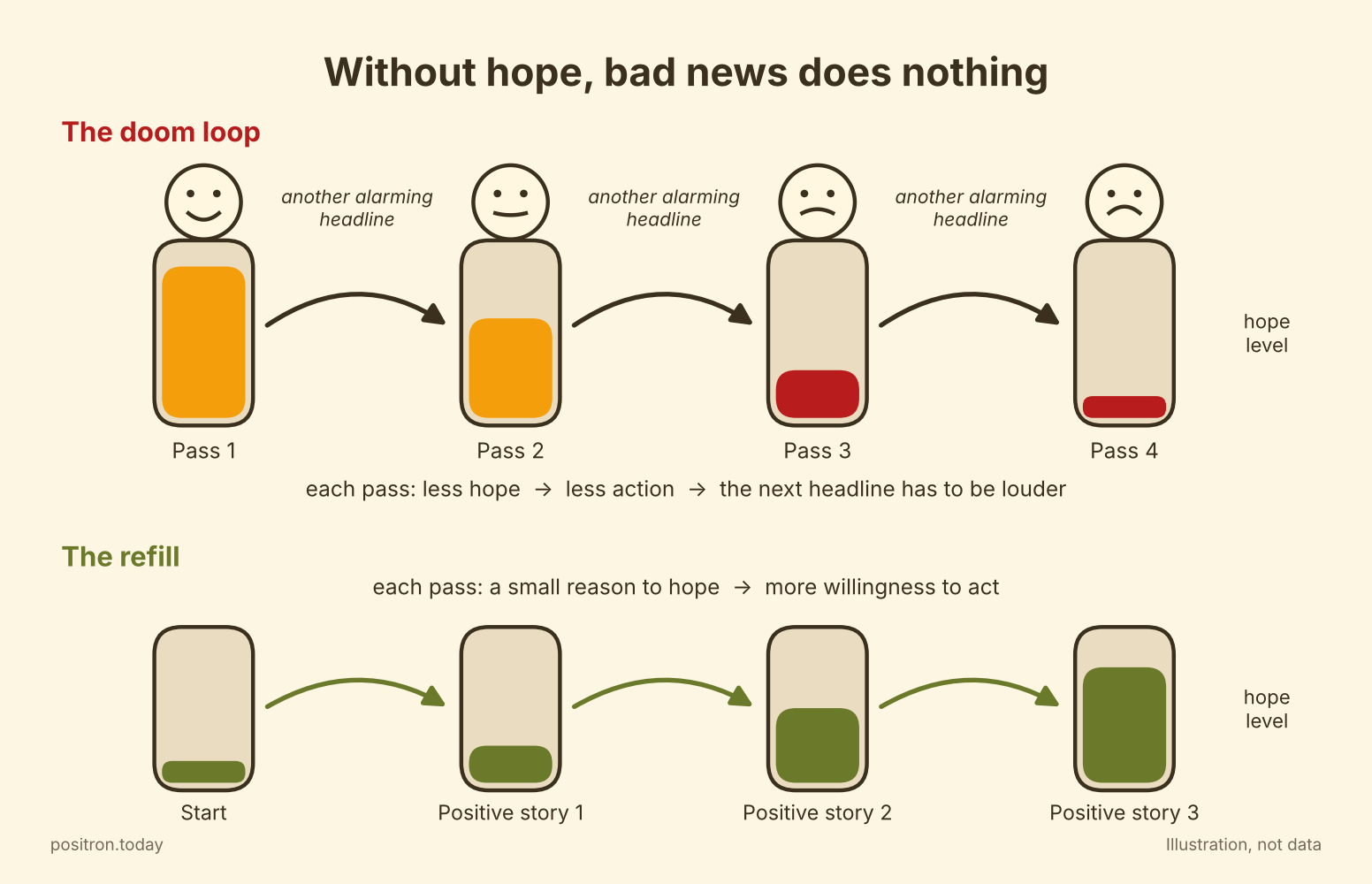
So you get a loop. Alarming headline, less hope, less action, and then the next headline has to be even louder to get through. Each pass leaves less in the tank. (That is what the illustration at the top shows.)
Where Positron fits
This is another reason why I think a positive news filter is useful, and I want to be careful about how I say it.
Positron does not tell you what to do about climate change. Van Bavel's research is about hope that is connected to action, for example the emotional benefits of taking part. A good news story about a solar farm or a recovering species is not the same thing, and I will not pretend it is.
What it does do, every day, is show that things get better when people work on them. It gives a steady, small reason to hope. And as Van Bavel puts it, to motivate people in the face of dire threats, we must give them a reason to hope. Without that, he says, "we are destined to doomscroll while the world burns."
So I see Positron as the refill station in the loop. It does not replace the serious news. It is what makes the serious news bearable, and so possible to act on.
What I would suggest
Read the hard news. Please do. And then, on the same day, look at one story about something that went right. Not to look away from the problem, but to remember why it is worth working on.
If you think I am stretching the research too far, tell me. I would like to hear it.
Cheers
Rik
Source: Jay Van Bavel, "The problem with telling people the world is ending", The Guardian, 18 October 2026.
Zonder hoop doet slecht nieuws niets
Dit resultaat verraste me. In een groot onderzoek naar klimaatboodschappen was de somberste en angstaanjagendste tekst degene die mensen online het vaakst deelden. Maar mensen daadwerkelijk iets laten doen, daar was die tekst ook het slechtst in.
Ik las dit in een recent artikel in The Guardian van Jay Van Bavel, hoogleraar psychologie aan NYU. Het sluit nauw aan bij wat ik vorige keer schreef, en voegt de helft toe die ik achterwege liet.
Waar we gebleven waren
In dat opiniestuk betoogde ik dat het negatieve nieuws dat er echt toe doet, zoals klimaatnieuws, niet het nieuws is dat Positron eruit filtert. Het probleem is de stortvloed aan goedkope, luidruchtige negativiteit, omdat die de belangrijke verhalen bedelft. Ik denk nog steeds dat dat klopt.
Maar er is een tweede probleem. Zelfs als het belangrijke slechte nieuws wél doordringt, kan het om een andere reden tekortschieten: mensen moeten geloven dat er iets aan te doen is.
De doemboodschap waar niemand iets mee deed
Van Bavel en zijn collega’s testten 11 verschillende klimaatboodschappen bij 59,440 mensen in 63 landen. Een ervan was pure kommer en kwel. Die scoorde het best qua delen, maar verloor op alles wat ertoe doet. Het was de minst effectieve boodschap om mensen tot echte actie aan te zetten, zoals bomen planten. Ook vergrootte die het geloof in de klimaatcrisis niet en zorgde die niet voor meer steun voor klimaatbeleid.
De rustige boodschap deed het beter. Daarin stond simpelweg dat de aarde opwarmt door menselijk handelen en dat 99% van de klimaatwetenschappers het daarmee eens is. Die boodschap versloeg de negatieve boodschap op alle uitkomsten, behalve op delen.
Ik vind dit een mooi resultaat, omdat het beide kanten van mijn betoog overeind houdt. De feiten zijn niet het probleem. Je kunt en moet mensen de harde waarheid vertellen. Het probleem is de doemretoriek eromheen, het gevoel dat het al te laat is en dat wat je ook doet toch geen verschil maakt.
Waarom meer alarm niet helpt
Van Bavel legt het mechanisme goed uit. Angst kan mensen tot actie aanzetten, maar meestal maar één keer, en alleen als de boodschap ook een gevoel van handelingsperspectief biedt: het geloof dat het nog mogelijk is om verschil te maken. Zonder dat bevriezen mensen. En als er steeds enge verhalen blijven komen, haken mensen af, net als in het verhaal van de jongen die wolf riep.
Onze feeds maken dit erger. Hij bekeek 22,743 koppentests op Upworthy en ontdekte dat elk extra negatief woord in een kop 2.3% meer klikken opleverde. Slecht nieuws wint elke keer de strijd om aandacht. Dat is dezelfde motor die ik beschreef in waarom je feed wil dat je boos bent.
Zo ontstaat een lus. Alarmerende kop, minder hoop, minder actie, en dan moet de volgende kop nóg luider zijn om door te dringen. Elke ronde laat minder energie over. (Dat is wat de illustratie bovenaan laat zien.)
Waar Positron past
Dit is nog een reden waarom ik denk dat een positieve nieuwsfilter nuttig is, en ik wil zorgvuldig formuleren hoe ik dat zeg.
Positron vertelt je niet wat je aan klimaatverandering moet doen. Van Bavels onderzoek gaat over hoop die verbonden is met actie, bijvoorbeeld de emotionele voordelen van meedoen. Een goed nieuwsverhaal over een zonnepark of een herstellende diersoort is niet hetzelfde, en ik zal niet doen alsof dat wel zo is.
Wat Positron elke dag wél doet, is laten zien dat dingen beter worden wanneer mensen eraan werken. Het geeft een gestage, kleine reden om hoop te houden. En zoals Van Bavel het zegt: om mensen te motiveren ondanks ernstige dreigingen, moeten we ze een reden geven om te hopen. Zonder dat, zegt hij, "zijn we gedoemd te doomscrollen terwijl de wereld in brand staat."
Dus zie ik Positron als het hervulstation in de lus. Het vervangt het serieuze nieuws niet. Het maakt serieus nieuws draaglijk, en daardoor ook iets waar je naar kunt handelen.
Wat ik zou aanraden
Lees het harde nieuws. Alsjeblieft. En kijk dan diezelfde dag naar één verhaal over iets dat goed is gegaan. Niet om het probleem uit de weg te gaan, maar om te onthouden waarom het de moeite waard is om eraan te werken.
Als je vindt dat ik het onderzoek te ver oprek, laat het me weten. Ik hoor het graag.
Groeten,
Rik
Bron: Jay Van Bavel, "The problem with telling people the world is ending", The Guardian, 18 October 2026.
Sans espoir, les mauvaises nouvelles ne servent à rien
Voici un résultat qui m’a surpris. Dans une vaste étude sur les messages climatiques, le texte le plus sombre et le plus terrifiant est celui que les gens ont le plus partagé en ligne. C’était aussi le moins efficace pour inciter les gens à agir concrètement.
J’ai découvert cela dans un récent article du Guardian signé Jay Van Bavel, professeur de psychologie à NYU. Il rejoint ce que j’ai écrit la dernière fois, et apporte la moitié qui manquait à mon propos.
Où nous en étions
Dans cet éditorial, je soutenais que les nouvelles négatives qui comptent vraiment, comme celles sur le climat, ne sont pas celles que Positron filtre. Le problème, c’est le flot de négativité bon marché et assourdissante, qui noie les articles importants. Je pense toujours que c’est juste.
Mais il y a un deuxième problème. Même si les mauvaises nouvelles importantes nous parviennent, elles peuvent échouer pour une autre raison : les gens doivent croire qu’il est possible de faire quelque chose.
Le message catastrophiste auquel personne n’a donné suite
Van Bavel et ses collègues ont testé 11 messages différents sur le climat auprès de 59,440 personnes dans 63 pays. L’un d’eux était un pur message de désespoir et de catastrophisme. C’est celui qui a été le plus partagé, et celui qui a obtenu les pires résultats sur tous les plans importants. C’était le message le moins efficace pour inciter les gens à passer à l’action, par exemple en plantant des arbres. Il n’a pas non plus renforcé la conviction qu’il y a urgence climatique, ni le soutien aux politiques climatiques.
Le message posé a fait mieux. Il se contentait d’énoncer que la Terre se réchauffe en raison de l’activité humaine et que 99% des climatologues sont d’accord. Il a surpassé le message négatif sur tous les critères, sauf le partage.
J’aime ce résultat, parce qu’il protège les deux versants de mon argumentation. Les faits ne sont pas le problème. On peut et on doit dire la vérité, même quand elle est difficile à entendre. Le problème, c’est le catastrophisme qui l’entoure, ce sentiment qu’il est déjà trop tard et que rien de ce que vous faites n’y changera quoi que ce soit.
Pourquoi alarmer davantage n’aide pas
Van Bavel explique bien le mécanisme. La peur peut pousser les gens à agir, mais le plus souvent une seule fois, et seulement si le message leur donne aussi un sentiment d’efficacité : la conviction qu’il est encore possible de faire une différence. Sans cela, les gens se figent. Et si les histoires effrayantes se succèdent, les gens finissent par décrocher, comme dans l’histoire du garçon qui criait au loup.
Nos fils d’actualité aggravent les choses. Il a examiné 22,743 tests de titres sur Upworthy et constaté que chaque mot négatif supplémentaire dans un titre générait 2.3% de clics en plus. Les mauvaises nouvelles remportent la bataille de l’attention à chaque fois. C’est le même moteur que celui que j’ai décrit dans pourquoi votre fil veut vous rendre furieux.
On se retrouve donc pris dans une boucle. Un titre alarmant, moins d’espoir, moins d’action, puis le titre suivant doit être encore plus tonitruant pour qu’on le remarque. À chaque tour, il reste un peu moins de réserves. (C’est ce que montre l’illustration en haut.)
Où se situe Positron
C’est une autre raison pour laquelle je pense qu’un filtre d’actualités positives est utile, et je tiens à bien choisir mes mots.
Positron ne vous dit pas quoi faire face au changement climatique. Les recherches de Van Bavel portent sur un espoir lié à l’action, par exemple les bienfaits émotionnels de la participation. Une bonne nouvelle sur une ferme solaire ou une espèce en voie de rétablissement, ce n’est pas la même chose, et je ne prétendrai pas le contraire.
Ce que Positron fait, jour après jour, c’est montrer que les choses s’améliorent quand les gens s’y mettent. Il donne une petite raison d’espérer, constante. Et, comme le dit Van Bavel, pour motiver les gens face à des menaces terribles, nous devons leur donner une raison d’espérer. Sans cela, dit-il, « nous sommes condamnés à faire défiler les mauvaises nouvelles pendant que le monde brûle ».
Je vois donc Positron comme le point de recharge de cette boucle. Il ne remplace pas les nouvelles sérieuses. C’est ce qui rend les nouvelles sérieuses supportables, et donc permet d’agir.
Ce que je suggérerais
Lisez les nouvelles difficiles. S’il vous plaît, faites-le. Et puis, le même jour, lisez une histoire sur quelque chose qui s’est bien passé. Non pas pour détourner le regard du problème, mais pour vous rappeler pourquoi il vaut la peine de s’y attaquer.
Si vous pensez que je pousse les conclusions de cette recherche trop loin, dites-le-moi. J’aimerais vous entendre.
À bientôt
Rik
Source : Jay Van Bavel, "Le problème quand on dit aux gens que le monde va finir", The Guardian, 18 October 2026.