How M.C. Escher’s art creates bizarre mathematical worldsHoe de kunst van M.C. Escher bizarre wiskundige werelden scheptComment l’art de M.C. Escher crée des mondes mathématiques étonnants
Quanta Magazine · 19 November 2026, at 10:07
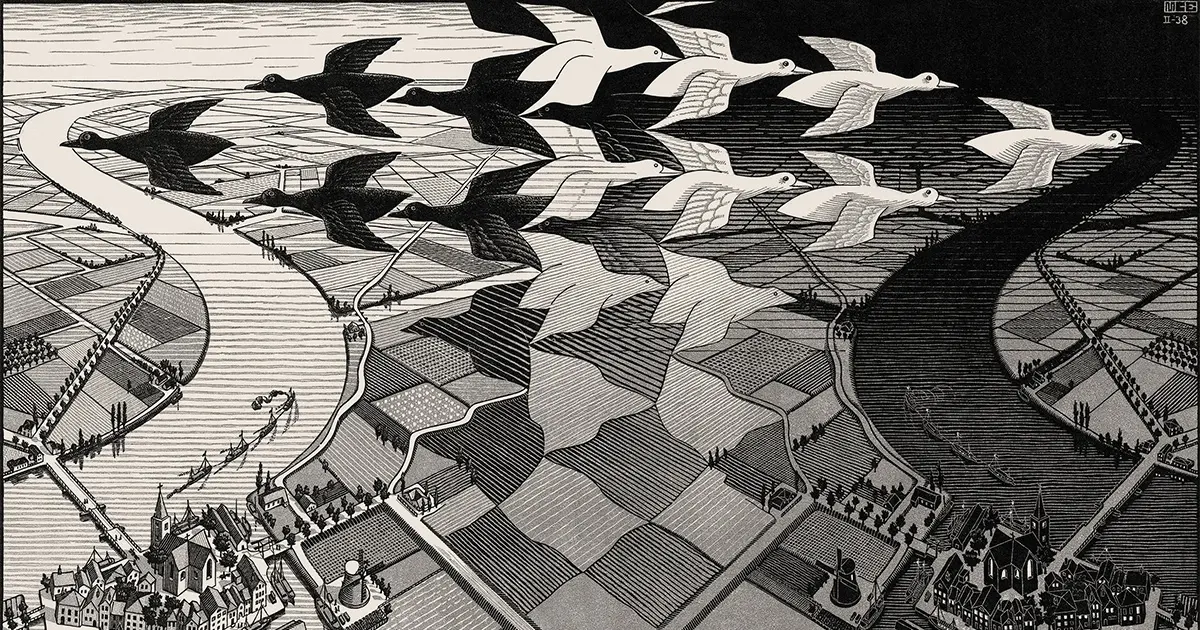
So, here’s the fascinating twist: M.C. Escher struggled with maths at school, yet his art became a lasting source of inspiration for mathematicians. His fascination with patterns at Granada’s Alhambra led him to explore how repeating shapes could fill a surface, and he developed striking tessellations featuring creatures like fish, birds and lizards. His intuitive discoveries about symmetry caught the attention of mathematicians and crystallographers, while his exchange with geometer H.S.M. Coxeter helped inspire some of his most complex work. A new exhibition at New York’s National Museum of Mathematics celebrates this creative journey through February 8, 2027.En hier komt de fascinerende wending: M.C. Escher had moeite met wiskunde op school, maar zijn kunst werd een blijvende inspiratiebron voor wiskundigen. Zijn belangstelling voor de patronen in het Alhambra in Granada bracht hem ertoe te onderzoeken hoe herhaalde vormen een oppervlak volledig kunnen bedekken, en hij ontwikkelde opvallende vlakvullingen met vissen, vogels en hagedissen. Zijn intuïtieve ontdekkingen over symmetrie trokken de aandacht van wiskundigen en kristallografen, terwijl zijn briefwisseling met meetkundige H.S.M. Coxeter enkele van zijn ingewikkeldste werken inspireerde. Een nieuwe tentoonstelling in het National Museum of Mathematics in New York viert deze creatieve ontdekkingstocht tot en met 8 februari 2027.Et voici le détail fascinant : M.C. Escher avait des difficultés en mathématiques à l’école, mais son art est devenu une source d’inspiration durable pour les mathématiciens. Sa fascination pour les motifs de l’Alhambra, à Grenade, l’a conduit à explorer comment des formes répétées pouvaient recouvrir une surface, et il a créé des pavages saisissants peuplés de poissons, d’oiseaux et de lézards. Ses découvertes intuitives sur la symétrie ont attiré l’attention de mathématiciens et de cristallographes, tandis que ses échanges avec le géomètre H.S.M. Coxeter ont inspiré certaines de ses œuvres les plus complexes. Une nouvelle exposition au National Museum of Mathematics de New York célèbre ce parcours créatif jusqu’au 8 février 2027.