Where your attention goes
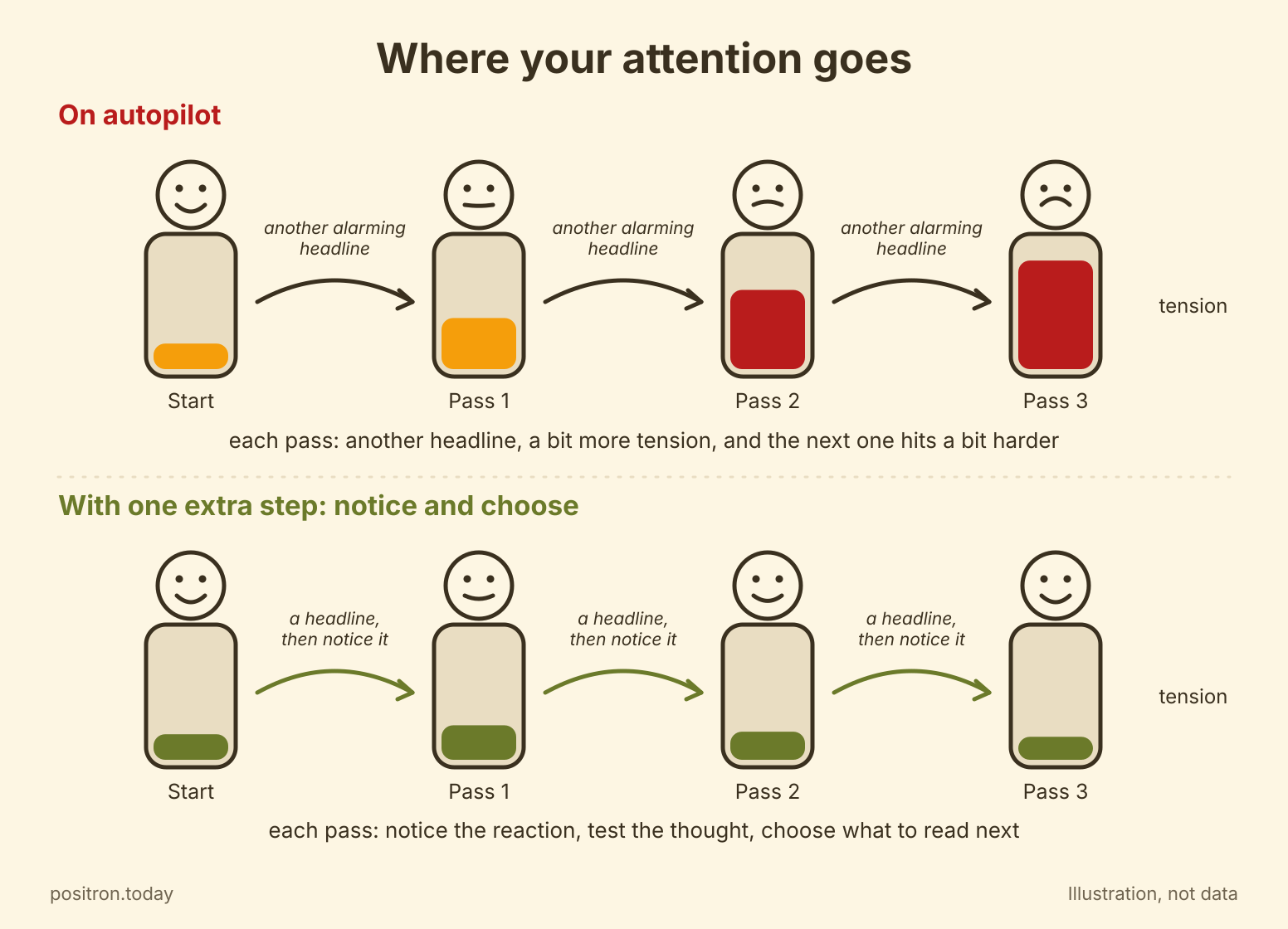
At the end of my last editorial I made a small suggestion: read the hard news, and then, on the same day, read one story about something that went well. That leaves a question open. What is actually happening inside us when we do that? And can we get better at it?
One book that shaped how I think about this is The Coddling of the American Mind by Greg Lukianoff and Jonathan Haidt. It is mostly about students and campuses, so it may seem like an odd place to look. But a big part of it is about something much more general: how our thinking can go wrong, and what we can do about it. More on that below.
Where we left it
In the memory that ate the news I described a loop: bad news is easy to remember, so the world starts to feel worse than it is, so we go looking for even more bad news. In the lazy brain and the bad news I argued that negativity is the lazy option, a reflex that runs for free, and that pointing our attention somewhere better takes a bit of deliberate effort, like taking the stairs. And in Without hope, bad news does nothing I looked at what that same loop does to our hope, and so to our willingness to act.
Three editorials, one thread: what we pay attention to shapes how we feel, and what we do. What I never really said is how to practise that. This editorial is my attempt at an answer. It's a small answer, and I will try to be honest about what I know and what I don't.
What we know, and what we don't
First things first: negative news changes how we feel. In a 1997 experiment, people watched a 14-minute news bulletin. Those who saw the negative one became more anxious and sadder, and they also catastrophized a personal worry more (Johnston & Davey). Other experiments point the same way, although not everybody is affected to the same degree (de Hoog & Verboon).
It's also not only about the news itself, but about how we consume it. After the Boston Marathon bombings, repeated exposure to the coverage was linked to more acute stress than having been there in person (Holman and colleagues). In a survey of about 1,100 US adults, 16.5% showed "severely problematic" news habits and reported much worse mental health. The authors argue that the way people consume news matters more than the amount, and they admit that a one-time survey can't prove cause and effect (summary).
A lot of people have already figured this out for themselves. According to the Reuters Institute, 40% of people now sometimes or often avoid the news, up from 29% in 2017, and the most common reason is the effect on their mood (Digital News Report 2025).
Now, the bigger picture. Anxiety and depression have been rising for a long time. Over four decades, adolescent depression and anxiety went up in many countries, with more than a 50% increase among 11-16 year olds in the UK (review). In the US, Gallup found that 18.3% of adults currently have or are treated for depression in 2025, and among adults under 30 the rate doubled from 13.0% in 2017 to 26.7% (Gallup). Part of that is probably better detection and less stigma, but not all of it. The Coddling of the American Mind starts from the same worry, about young people in particular.
So let me be careful here. I can't tell you that bad news causes any of this. Plenty of other things moved in the same period, and Gallup, for example, links depression strongly to loneliness. But two things are true at the same time: many people are struggling, and many of us swim in a stream of negative news that we know pushes mood and worry in the wrong direction. A more balanced news diet is one small thing that is within our reach.
Mindfulness is about noticing
Which brings me to mindfulness. It can sound vague and a bit soft, but the core idea is very simple: you pay attention to what is happening right now, including what is happening inside your own head, and you try not to judge it. Applied to the news, that means one small question - what is this headline doing to me right now?
The evidence for mindfulness is real, but modest. A large review of 47 trials found moderate evidence for small to moderate improvements in anxiety and depression, and no evidence that meditation beats other active treatments (Goyal et al.). So it's not magic. It is one useful tool among others.
There are also a few early signs that it helps with news in particular. In one study, people who did 10 minutes of guided mindfulness a day for 10 days were not emotionally affected by COVID news in their daily check-ins, while the people in the control group felt worse after the news (Greater Good). The researcher behind the doomscrolling survey also sees preliminary signs that people with higher mindfulness are less likely to develop problematic news habits, and wants to test that properly (MDedge). These studies are small and early, so I'd call this a promising lead, not a proven fact.
Notice what mindfulness does not ask you to do. It doesn't ask you to look away from the world. It asks you to look at your own reaction, and to choose what you do next.
A cognitive behavioural lens
This is where The Coddling of the American Mind was useful to me. Lukianoff and Haidt use cognitive behavioural therapy (CBT) as a framework to explain how our thinking can go wrong (review). CBT teaches you to recognise "cognitive distortions" - habits of thought that make the world look worse than it is.
Two of them fit a bad-news diet almost too well. One is catastrophizing: focusing on the worst possible outcome and treating it as the most likely one. The other is negative filtering: highlighting the bad experiences and playing down the good ones. And remember the 1997 experiment: negative news made people catastrophize their own personal worries more.
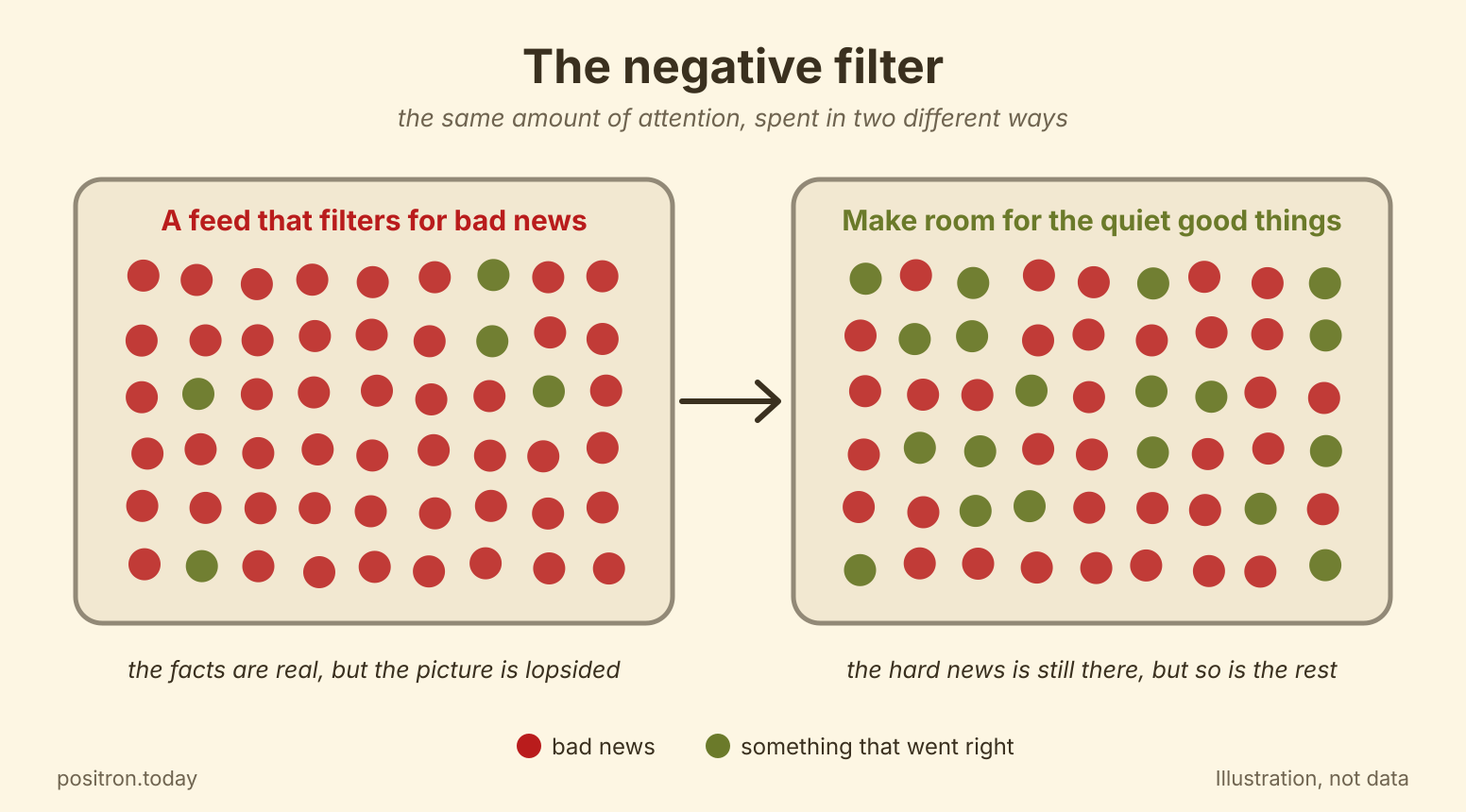
A feed that is made of bad news is a filter. It doesn't lie, exactly. It just shows you one side of what is happening, all day long, and the mind starts to treat that as the whole picture. (Our attention is limited. The picture above shows the same amount of it, spent in two different ways.)
The CBT answer is not to stop feeling, and not to look away. It is to test the thought. You ask what the evidence is for it and what the evidence is against it, and then you look again at how you feel. If a thought like "nothing good is happening in the world" has a few real counterexamples next to it, it gets harder to believe.
One honest note: I couldn't find a solid trial that tests CBT on news habits specifically. So this is a lens, not a treatment. And if the news, or anything else, is really weighing on you, talk to a professional.
Where Positron fits in
Positron.today is a hobby project. It is non-commercial, it publishes in English, Dutch and French, and it should never be anyone's main source of information. I want to be very clear about that.
What it can be is a counterweight. It's a place where the good things that happen get the same fair attention that the bad things get everywhere else. Think of it as evidence for the other side of the scale, the kind of evidence a negative filter keeps out. Research on constructive and solutions-focused news suggests that this kind of reporting lifts mood, although the effect on trust and knowledge is less clear (Constructive Institute review - they are an advocacy group, so read it with that in mind).
Now, you may be thinking: isn't this exactly the coddling that the book warns about? Fair question, and one I've touched on before: in the lazy brain and the bad news I argued that chosen discomfort is healthy. The Coddling of the American Mind argues that protecting people from discomfort backfires,.
But this is not about hiding. Read the serious news. Stay informed. The point is to notice the effect the news has on you, not to switch it all off. Positron doesn't replace the news. It adds balance to it, so that the picture in your head gets a bit closer to the real one.
A small habit to try
In my last editorial I suggested pairing hard news with one positive story. Here's a slightly longer version of that experiment, with one extra step - noticing:
- Read your usual news, and then stop for a moment. Ask yourself how you feel: tense, flat, worried, fine?
- Name what you notice. Is the thought "everything is going wrong" in there somewhere? Ask what the evidence is for it, and what the evidence is against it.
- Spend a few minutes somewhere that shows what is going well, for example Positron.today, and check in again.
Then compare. I don't know what you will find, and it may be different for everyone. That's the point: you look at where your attention goes, and you get to choose it. (That is what the illustration at the top shows: the same headlines, but with one extra step in the loop.)
That is also what Positron is for. It exists to give positive news a fair place, so that the picture we carry around in our heads gets a little more balanced. I can't promise it will fix anything big. But noticing is a good place to start.
Hope this was useful - and if you think I am stretching the research too far, tell me. I would like to hear it.
Cheers
Rik
Waar je aandacht naartoe gaat
Aan het einde van mijn vorige editorial deed ik een kleine suggestie: lees het harde nieuws en lees dan op dezelfde dag één verhaal over iets dat goed is gegaan. Dat laat een vraag open. Wat gebeurt er eigenlijk in ons als we dat doen? En kunnen we er beter in worden?
Een boek dat mijn denken hierover heeft gevormd, is The Coddling of the American Mind van Greg Lukianoff en Jonathan Haidt. Het gaat vooral over studenten en universiteitscampussen, dus het lijkt misschien een vreemde plek om te kijken. Maar een groot deel ervan gaat over iets veel algemeners: hoe ons denken de verkeerde kant op kan gaan en wat we daaraan kunnen doen. Daarover hieronder meer.
Waar we waren gebleven
In het geheugen dat het nieuws opat beschreef ik een lus: slecht nieuws onthouden we gemakkelijk, waardoor de wereld erger begint te voelen dan hij is, waarna we op zoek gaan naar nóg meer slecht nieuws. In het luie brein en het slechte nieuws betoogde ik dat negativiteit de luie optie is, een reflex die vanzelf aanslaat, en dat onze aandacht ergens beters op richten een beetje bewuste inspanning kost, zoals de trap nemen. En in Zonder hoop doet slecht nieuws niets keek ik naar wat diezelfde lus met onze hoop doet, en dus met onze bereidheid om in actie te komen.
Drie editorials, één rode draad: waar we aandacht aan besteden, bepaalt hoe we ons voelen en wat we doen. Wat ik nooit echt heb gezegd, is hoe je dat kunt oefenen. Deze editorial is mijn poging om daar een antwoord op te geven. Het is een klein antwoord, en ik zal proberen eerlijk te zijn over wat ik wel en niet weet.
Wat we wel weten en wat niet
Om te beginnen: negatief nieuws verandert hoe we ons voelen. In een experiment uit 1997 keken mensen naar een nieuwsbulletin van 14 minuten. Degenen die de negatieve versie zagen, werden angstiger en somberder, en maakten zich ook meer zorgen over een persoonlijk probleem (Johnston & Davey). Andere experimenten wijzen in dezelfde richting, al is niet iedereen in dezelfde mate vatbaar voor dat effect (de Hoog & Verboon).
Het gaat bovendien niet alleen om het nieuws zelf, maar ook om hoe we het consumeren. Na de bomaanslagen bij de Boston Marathon hing herhaalde blootstelling aan de berichtgeving samen met meer acute stress dan er zelf bij zijn geweest (Holman and colleagues). In een enquête onder ongeveer 1,100 volwassenen in de VS vertoonde 16.5% "ernstig problematische" nieuwsroutines en rapporteerde die groep een veel slechtere mentale gezondheid. De auteurs stellen dat de manier waarop mensen nieuws consumeren er meer toe doet dan de hoeveelheid, en geven toe dat je met een eenmalige enquête geen oorzaak en gevolg kunt aantonen (samenvatting).
Veel mensen hebben dit zelf al door. Volgens het Reuters Institute mijdt 40% van de mensen het nieuws nu soms of vaak, tegenover 29% in 2017, en de meest genoemde reden is het effect op hun stemming (Digital News Report 2025).
En dan het grotere plaatje. Angst en depressie nemen al lange tijd toe. In vier decennia namen depressie en angst onder jongeren in veel landen toe, met een stijging van meer dan 50% onder 11-16 jarigen in het VK (overzicht). In de VS stelde Gallup vast dat 18.3% van de volwassenen in 2025 momenteel een depressie heeft of daarvoor wordt behandeld, en dat het percentage onder volwassenen jonger dan 30 verdubbelde van 13.0% in 2017 naar 26.7% (Gallup). Een deel daarvan komt waarschijnlijk doordat depressie beter wordt vastgesteld en er minder stigma op rust, maar niet alles. The Coddling of the American Mind vertrekt vanuit dezelfde bezorgdheid, met name over jonge mensen.
Dus laat ik hier voorzichtig zijn. Ik kan je niet vertellen dat slecht nieuws dit allemaal veroorzaakt. In dezelfde periode zijn er tal van andere dingen veranderd, en Gallup brengt depressie bijvoorbeeld sterk in verband met eenzaamheid. Maar twee dingen zijn tegelijkertijd waar: veel mensen hebben het moeilijk, en velen van ons zwemmen in een stroom negatief nieuws waarvan we weten dat die onze stemming en zorgen de verkeerde kant op stuurt. Een evenwichtiger nieuwsdieet is een kleine stap die we zelf kunnen zetten.
Mindfulness draait om opmerken
Dat brengt me bij mindfulness. Het kan vaag en een beetje soft klinken, maar het basisidee is heel eenvoudig: je let op wat er op dit moment gebeurt, ook op wat er in je eigen hoofd gebeurt, en je probeert daar niet over te oordelen. Toegepast op het nieuws betekent dat één kleine vraag: wat doet deze kop op dit moment met mij?
Het bewijs voor mindfulness is reëel, maar bescheiden. Een groot overzicht van 47 onderzoeken vond matig bewijs voor kleine tot middelgrote verbeteringen in angst en depressie, en geen bewijs dat meditatie beter werkt dan andere actieve behandelingen (Goyal et al.). Het is dus geen magie. Het is een bruikbaar hulpmiddel naast andere.
Er zijn ook een paar eerste aanwijzingen dat mindfulness specifiek bij nieuws kan helpen. In één onderzoek werden mensen die 10 minuten per dag gedurende 10 dagen geleide mindfulness beoefenden, tijdens hun dagelijkse check-ins emotioneel niet geraakt door COVID-nieuws, terwijl de mensen in de controlegroep zich na het nieuws slechter voelden (Greater Good). De onderzoeker achter de enquête over doomscrollen ziet ook voorlopige aanwijzingen dat mensen met meer mindfulness minder snel problematische nieuwsroutines ontwikkelen, en wil dat goed onderzoeken (MDedge). Deze onderzoeken zijn klein en staan nog in de kinderschoenen, dus ik zou dit een veelbelovende aanwijzing noemen, geen bewezen feit.
Let op wat mindfulness je níét vraagt te doen. Het vraagt je niet om je af te wenden van de wereld. Het vraagt je om je eigen reactie op te merken en te kiezen wat je daarna doet.
Een cognitief-gedragstherapeutische blik
Hier was The Coddling of the American Mind nuttig voor mij. Lukianoff en Haidt gebruiken cognitieve gedragstherapie (CGT) als kader om uit te leggen hoe ons denken de verkeerde kant op kan gaan (bespreking). CGT leert je om "cognitieve vertekeningen" te herkennen: denkgewoonten die de wereld erger laten lijken dan hij is.
Twee daarvan passen bijna té goed bij een dieet van slecht nieuws. De ene is catastroferen: je richten op de slechtst mogelijke uitkomst en die behandelen alsof ze het waarschijnlijkst is. De andere is negatieve filtering: de slechte ervaringen uitlichten en de goede bagatelliseren. En denk aan het experiment uit 1997: negatief nieuws zorgde ervoor dat mensen zich meer catastrofaal zorgen maakten over hun eigen persoonlijke problemen.
Een feed die uit slecht nieuws bestaat, is een filter. Hij liegt niet, precies. Hij laat je gewoon de hele dag maar één kant zien van wat er gebeurt, en je brein begint dat als het hele plaatje te beschouwen. (Onze aandacht is beperkt. De afbeelding hierboven laat zien hoe je diezelfde hoeveelheid op twee verschillende manieren kunt besteden.)
Het antwoord van CGT is niet om op te houden met voelen en ook niet om weg te kijken. Het is om de gedachte te toetsen. Je vraagt welk bewijs ervoor is en welk bewijs ertegen is, en kijkt dan opnieuw naar hoe je je voelt. Als je bij een gedachte als "er gebeurt niets goeds in de wereld" een paar echte tegenvoorbeelden kunt noemen, wordt het moeilijker om erin te geloven.
Eén eerlijke kanttekening: ik kon geen degelijk onderzoek vinden waarin CGT specifiek op nieuwsroutines wordt getest. Zie dit dus als een denkkader, niet als een behandeling. En als het nieuws, of iets anders, je echt zwaar valt, praat dan met een professional.
Waar Positron past
Positron.today is een hobbyproject. Het is niet-commercieel, publiceert in het Engels, Nederlands en Frans, en mag nooit iemands belangrijkste informatiebron zijn. Daar wil ik heel duidelijk over zijn.
Wat het wel kan zijn, is een tegenwicht. Het is een plek waar goede dingen die gebeuren evenveel eerlijke aandacht krijgen als slechte dingen elders. Zie het als bewijs voor de andere kant van de weegschaal, het soort bewijs dat een negatieve filter buiten beeld houdt. Onderzoek naar constructief en oplossingsgericht nieuws suggereert dat dit soort verslaggeving de stemming verbetert, al is het minder duidelijk wat het effect is op vertrouwen en kennis (overzicht van het Constructive Institute - zij zijn een belangenorganisatie, dus lees het met dat in gedachten).
Misschien denk je nu: is dit niet precies het betuttelen waar het boek voor waarschuwt? Een terechte vraag, en een waar ik het eerder over heb gehad: in het luie brein en het slechte nieuws betoogde ik dat gekozen ongemak gezond is. The Coddling of the American Mind stelt dat mensen beschermen tegen ongemak averechts werkt,.
Maar dit gaat niet over je verstoppen. Lees het serieuze nieuws. Blijf op de hoogte. Het gaat erom op te merken welk effect het nieuws op je heeft, niet om alles uit te zetten. Positron vervangt het nieuws niet. Het brengt er balans in, zodat het beeld in je hoofd iets dichter bij de werkelijkheid komt.
Een kleine gewoonte om uit te proberen
In mijn vorige editorial stelde ik voor om hard nieuws te combineren met één positief verhaal. Hier is een iets langere versie van dat experiment, met één extra stap: opmerken.
- Lees je gebruikelijke nieuws en stop dan even. Vraag jezelf af hoe je je voelt: gespannen, vlak, bezorgd, prima?
- Benoem wat je opmerkt. Zit de gedachte "alles gaat mis" er ergens tussen? Vraag welk bewijs ervoor is en welk bewijs ertegen is.
- Breng een paar minuten door op een plek die laat zien wat er goed gaat, bijvoorbeeld Positron.today, en ga dan opnieuw bij jezelf na hoe je je voelt.
Vergelijk daarna. Ik weet niet wat je zult merken, en voor iedereen kan dat anders zijn. Dat is precies het punt: je kijkt waar je aandacht naartoe gaat en je kunt ervoor kiezen die ergens anders op te richten. (Dat laat de afbeelding bovenaan zien: dezelfde koppen, maar met één extra stap in de lus.)
Daar is Positron ook voor. Het is er om positief nieuws een eerlijke plek te geven, zodat het beeld dat we in ons hoofd meedragen wat evenwichtiger wordt. Ik kan niet beloven dat het iets groots zal oplossen. Maar opmerken is een goede plek om te beginnen.
Ik hoop dat dit nuttig was — en als je vindt dat ik het onderzoek te ver oprek, laat het me weten. Ik hoor het graag.
Groeten,
Rik
Où va votre attention
À la fin de mon dernier éditorial, j’ai fait une petite suggestion : lisez les nouvelles difficiles, puis, le même jour, lisez un article sur quelque chose qui s’est bien passé. Cela laisse une question en suspens. Que se passe-t-il réellement en nous quand nous faisons cela ? Et peut-on apprendre à mieux le faire ?
Un livre qui a façonné ma façon de voir les choses est The Coddling of the American Mind de Greg Lukianoff et Jonathan Haidt. Il parle surtout des étudiants et des campus, alors cela peut sembler un endroit étrange où chercher. Mais il traite en grande partie de quelque chose de beaucoup plus général : comment notre pensée peut dérailler, et ce que nous pouvons y faire. J’y reviendrai plus bas.
Où nous en étions
Dans le souvenir qui a dévoré l’actualité, j’ai décrit une boucle : les mauvaises nouvelles sont faciles à retenir, alors le monde commence à nous sembler pire qu’il ne l’est, et nous partons à la recherche d’encore plus de mauvaises nouvelles. Dans le cerveau paresseux et les mauvaises nouvelles, j’ai avancé que la négativité est l’option de facilité, un réflexe qui se déclenche gratuitement, et que diriger notre attention vers quelque chose de plus positif demande un petit effort délibéré, comme prendre les escaliers. Et dans Sans espoir, les mauvaises nouvelles ne servent à rien, je me suis penché sur les effets de cette même boucle sur notre espoir, et donc sur notre volonté d’agir.
Trois éditoriaux, un même fil conducteur : ce à quoi nous prêtons attention façonne ce que nous ressentons et ce que nous faisons. Ce que je n’ai jamais vraiment expliqué, c’est comment s’y exercer. Cet éditorial est ma tentative de réponse. C’est une réponse modeste, et je vais essayer d’être honnête sur ce que je sais et ce que j’ignore.
Ce que nous savons, et ce que nous ignorons
Commençons par le commencement : les nouvelles négatives changent ce que nous ressentons. Dans une expérience menée en 1997, des personnes ont regardé un journal télévisé de 14 minutes. Celles qui ont vu le journal négatif sont devenues plus anxieuses et plus tristes, et elles ont aussi davantage catastrophisé à propos d’une inquiétude personnelle (Johnston & Davey). D’autres expériences vont dans le même sens, même si tout le monde n’est pas touché au même degré (de Hoog & Verboon).
Ce n’est pas seulement une question des nouvelles elles-mêmes, mais aussi de la façon dont nous les consommons. Après les attentats du marathon de Boston, une exposition répétée à leur couverture médiatique a été associée à un stress aigu plus important que le fait d’avoir été sur place (Holman et ses collègues). Dans une enquête menée auprès d’environ 1,100 adultes américains, 16.5% avaient des habitudes d’information « gravement problématiques » et déclaraient une santé mentale bien plus mauvaise. Les auteurs avancent que la manière dont les gens consomment les nouvelles compte davantage que la quantité, et reconnaissent qu’une enquête ponctuelle ne peut pas prouver un lien de cause à effet (résumé).
Beaucoup de gens l’ont déjà compris par eux-mêmes. Selon le Reuters Institute, 40% des gens évitent désormais parfois ou souvent les nouvelles, contre 29% en 2017, et la raison la plus souvent invoquée est leur effet sur l’humeur (Digital News Report 2025).
Passons maintenant à une vue d’ensemble. L’anxiété et la dépression sont en hausse depuis longtemps. Sur quatre décennies, la dépression et l’anxiété chez les adolescents ont augmenté dans de nombreux pays, avec une hausse de plus de 50% chez les 11-16 ans au Royaume-Uni (revue). Aux États-Unis, Gallup a constaté que 18.3% des adultes souffrent actuellement de dépression ou sont traités pour cela en 2025, et que chez les adultes de moins de 30 ans, le taux a doublé, passant de 13.0% en 2017 à 26.7% (Gallup). Une partie de cette évolution est probablement due à un meilleur dépistage et à une stigmatisation moindre, mais pas entièrement. The Coddling of the American Mind part de la même inquiétude, en particulier à propos des jeunes.
Alors, permettez-moi d’être prudent. Je ne peux pas vous dire que les mauvaises nouvelles sont la cause de tout cela. Bien d’autres choses ont évolué au cours de la même période, et Gallup, par exemple, établit un lien étroit entre la dépression et la solitude. Mais deux choses sont vraies en même temps : beaucoup de gens sont en difficulté, et beaucoup d’entre nous sont immergés dans un flux de nouvelles négatives dont nous savons qu’elles poussent l’humeur et l’inquiétude dans la mauvaise direction. Une alimentation médiatique plus équilibrée est une petite chose que nous pouvons faire.
La pleine conscience, c’est remarquer
Ce qui m’amène à la pleine conscience. Cela peut sembler vague et un peu mièvre, mais l’idée de base est très simple : prêter attention à ce qui se passe ici et maintenant, y compris à ce qui se passe dans sa propre tête, et essayer de ne pas porter de jugement. Appliquée aux nouvelles, cela revient à se poser une petite question : qu’est-ce que ce gros titre me fait en ce moment ?
Les preuves en faveur de la pleine conscience sont réelles, mais modestes. Une vaste revue de 47 essais a trouvé des preuves modérées d’améliorations faibles à modérées de l’anxiété et de la dépression, et aucune preuve que la méditation soit supérieure à d’autres traitements actifs (Goyal et al.). Ce n’est donc pas magique. C’est un outil utile parmi d’autres.
On observe aussi quelques premiers signes qu’elle peut aider en particulier face aux nouvelles. Dans une étude, les personnes qui ont suivi 10 minutes de méditation guidée par jour pendant 10 jours n’ont pas été affectées émotionnellement par les nouvelles sur le COVID lors de leurs bilans quotidiens, tandis que les personnes du groupe témoin se sentaient plus mal après les avoir regardées (Greater Good). Le chercheur à l’origine de l’enquête sur le doomscrolling observe également des signes préliminaires indiquant que les personnes ayant une plus grande pleine conscience sont moins susceptibles de développer des habitudes d’information problématiques, et souhaite le vérifier rigoureusement (MDedge). Ces études sont petites et récentes ; je parlerais donc d’une piste prometteuse, pas d’un fait établi.
Remarquez ce que la pleine conscience ne vous demande pas de faire. Elle ne vous demande pas de détourner le regard du monde. Elle vous demande d’observer votre propre réaction et de choisir ce que vous faites ensuite.
Le prisme des thérapies cognitivo-comportementales
C’est là que The Coddling of the American Mind m’a été utile. Lukianoff et Haidt s’appuient sur la thérapie cognitivo-comportementale (TCC) pour expliquer comment notre pensée peut dérailler (critique). La TCC vous apprend à reconnaître les « distorsions cognitives » — des habitudes de pensée qui donnent du monde une image plus sombre qu’il ne l’est.
Deux d’entre elles correspondent presque trop bien à une alimentation composée de mauvaises nouvelles. La première est la catastrophisation : se focaliser sur le pire résultat possible et le considérer comme le plus probable. L’autre est le filtre négatif : mettre en avant les mauvaises expériences et minimiser les bonnes. Et souvenez-vous de l’expérience de 1997 : les nouvelles négatives poussaient les gens à davantage catastrophiser à propos de leurs propres inquiétudes.
Un fil d’actualité composé de mauvaises nouvelles est un filtre. Il ne ment pas, exactement. Il ne vous montre qu’un seul côté de ce qui se passe, toute la journée, et l’esprit finit par prendre cela pour le tableau complet. (Notre attention est limitée. L’image ci-dessus montre la même quantité d’attention, répartie de deux façons différentes.)
La réponse de la TCC n’est pas de cesser de ressentir, ni de détourner le regard. C’est de mettre sa pensée à l’épreuve. On se demande quelles preuves la soutiennent et quelles preuves la contredisent, puis on réexamine ce que l’on ressent. Si une pensée comme « rien de bon ne se passe dans le monde » se retrouve face à quelques contre-exemples bien réels, il devient plus difficile d’y croire.
Une remarque en toute honnêteté : je n’ai pas trouvé d’essai solide qui teste spécifiquement la TCC sur les habitudes liées aux nouvelles. C’est donc un prisme, pas un traitement. Et si les nouvelles, ou quoi que ce soit d’autre, vous pèsent vraiment, parlez-en à un professionnel.
La place de Positron
Positron.today est un projet amateur. Il n’a pas de but commercial, publie en anglais, en néerlandais et en français, et ne devrait jamais être la principale source d’information de qui que ce soit. Je tiens à le dire très clairement.
Ce qu’il peut être, c’est un contrepoids. C’est un endroit où les bonnes choses qui arrivent reçoivent la même attention équitable que les mauvaises en reçoivent partout ailleurs. Voyez-le comme des éléments qui font pencher la balance de l’autre côté, le genre d’éléments qu’un filtre négatif laisse de côté. Les recherches sur l’information constructive et axée sur les solutions suggèrent que ce type de journalisme améliore l’humeur, même si ses effets sur la confiance et les connaissances sont moins clairs (revue du Constructive Institute — il s’agit d’un groupe de défense de cette approche, alors gardez-le à l’esprit).
Vous vous dites peut-être : n’est-ce pas exactement le genre de protection excessive contre lequel le livre met en garde ? Bonne question, que j’ai déjà abordée : dans le cerveau paresseux et les mauvaises nouvelles, j’avançais qu’un inconfort choisi est sain. The Coddling of the American Mind soutient que protéger les gens de l’inconfort se retourne contre eux,.
Mais il ne s’agit pas de se cacher. Lisez les nouvelles sérieuses. Tenez-vous au courant. L’idée est de remarquer l’effet que les nouvelles ont sur vous, pas de tout éteindre. Positron ne remplace pas les nouvelles. Il les équilibre, pour que l’image que vous vous faites du monde soit un peu plus proche de la réalité.
Une petite habitude à essayer
Dans mon dernier éditorial, j’ai suggéré d’associer les nouvelles difficiles à un article positif. Voici une version un peu plus longue de cette expérience, avec une étape supplémentaire : remarquer.
- Lisez vos nouvelles habituelles, puis arrêtez-vous un instant. Demandez-vous comment vous vous sentez : tendu, à plat, inquiet, ça va ?
- Nommez ce que vous remarquez. La pensée « tout va mal » est-elle quelque part dans votre tête ? Demandez-vous quelles preuves la soutiennent et quelles preuves la contredisent.
- Passez quelques minutes dans un espace qui montre ce qui se passe bien, par exemple Positron.today, puis faites à nouveau le point.
Puis comparez. Je ne sais pas ce que vous constaterez, et cela peut varier d’une personne à l’autre. C’est justement le but : vous observez où va votre attention, et vous pouvez choisir. (C’est ce que montre l’illustration en haut : les mêmes gros titres, mais avec une étape supplémentaire dans la boucle.)
C’est aussi pour cela que Positron existe. Pour donner aux nouvelles positives la place qu’elles méritent, afin que l’image que nous gardons en tête soit un peu plus équilibrée. Je ne peux pas promettre que cela résoudra quoi que ce soit d’important. Mais remarquer, c’est un bon début.
J’espère que cela vous a été utile — et si vous pensez que je pousse les conclusions des recherches trop loin, dites-le-moi. J’aimerais le savoir.
Amicalement,
Rik