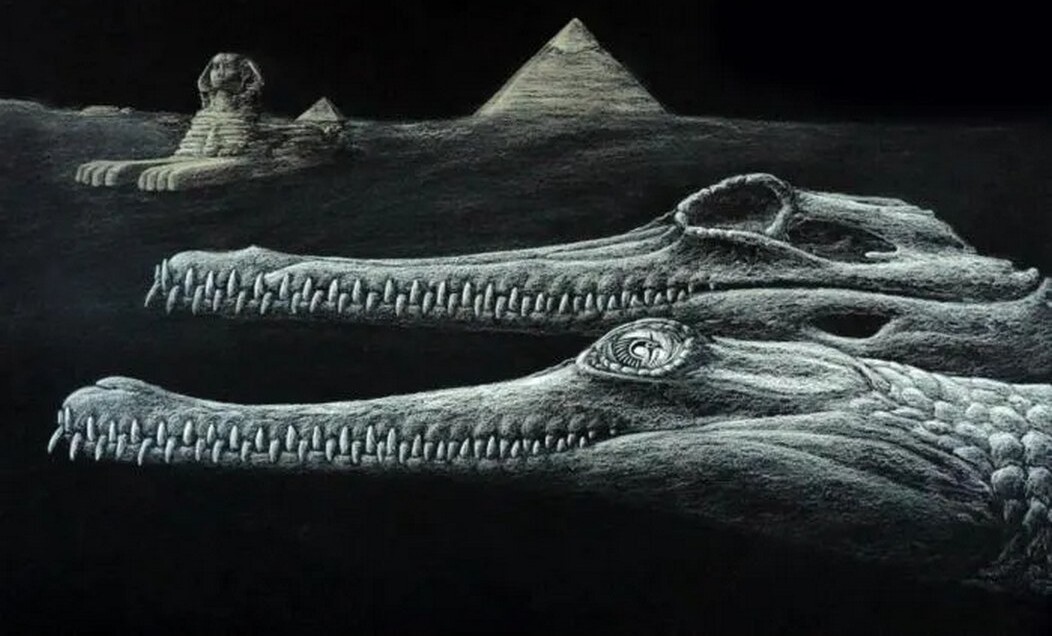
A new crocodilian fossil shares a curious link with the SphinxEen nieuw krokodillenfossiel deelt een bijzondere link met de SfinxUn nouveau fossile de crocodilien partage un lien étonnant avec le Sphinx
Good News Network · 16 October 2026, at 10:34
So: researchers have identified a new ancient crocodilian species from a 45-million-year-old rock layer in Egypt, the same formation quarried for stones used to build the Sphinx. CT scans revealed that its nearly complete skull did not belong to the gavial genus Tomistoma, as scientists had thought for more than a century. The newly named Herugavialis cairensis is also missing the tip of its snout, a striking coincidence with the Sphinx’s famously absent nose. Its discovery adds to evidence that gavials once lived across a much wider range of habitats, including the shallow seas of the ancient Mediterranean.Onderzoekers hebben een nieuwe, eeuwenoude krokodillensoort ontdekt in een 45 miljoen jaar oude Egyptische gesteentelaag, waaruit ook stenen werden gewonnen voor de bouw van de Sfinx. CT-scans lieten zien dat de bijna complete schedel niet behoort tot het gavialengeslacht Tomistoma, zoals wetenschappers ruim een eeuw dachten. De soort kreeg de naam Herugavialis cairensis en mist ook het puntje van haar snuit - een opvallende overeenkomst met de beroemde ontbrekende neus van de Sfinx. De vondst ondersteunt het bewijs dat gavialen vroeger in veel meer leefgebieden voorkwamen, waaronder de ondiepe zeeën van het oude Middellandse Zeegebied.Des chercheurs ont identifié une nouvelle espèce de crocodilien ancien dans une couche rocheuse égyptienne vieille de 45 millions d’années, dont les pierres ont aussi servi à construire le Sphinx. Des scanners ont révélé que son crâne presque complet n’appartenait pas au genre de gavial Tomistoma, contrairement à ce que les scientifiques pensaient depuis plus d’un siècle. Baptisée Herugavialis cairensis, l’espèce a elle aussi le bout du museau manquant - une coïncidence frappante avec le nez célèbre du Sphinx. Cette découverte renforce l’idée que les gavials vivaient autrefois dans une bien plus grande diversité d’habitats, notamment les mers peu profondes de l’ancienne Méditerranée.